NYTimes
November 26, 2006
‘Yours Truly,’ the E-Variations
By LOLA OGUNNAIKE
CHAD TROUTWINE, an entrepreneur in Malibu, Calif., was negotiating a commercial lease earlier this year for a building he owns in the Midwest. Though talks began well, they soon grew rocky. The telltale sign that things had truly devolved? The sign-offs on the e-mail exchanges with his prospective tenant.
“As negotiations started to break down, the sign-offs started to get decidedly shorter and cooler,” Mr. Troutwine recalled. “In the beginning it was like, ‘I look forward to speaking with you soon’ and ‘Warmest regards,’ and by the end it was just ‘Best.’ ” The deal was eventually completed, but Mr. Troutwine still felt as if he had been snubbed.
What’s in an e-mail sign-off? A lot, apparently. Those final few words above your name are where relationships and hierarchies are established, and where what is written in the body of the message can be clarified or undermined. In the days before electronic communication, the formalities of a letter, either business or personal, were taught to every third-grader; sign-offs — from “Sincerely” to “Yours truly” to “Love” — came to mind without much effort.
But e-mail is a casual medium, and its conventions are scarcely a decade old. They are still evolving, often awkwardly. It is common for business messages to appear entirely in lower case, and many rapid-fire correspondences evolve from formal to intimate in a few back-and-forths.
Although salutations that begin messages can be tricky — there is a world of difference, it seems, between a “Hi,” a “Hello” and a “Dear” — the sign-off is the place where many writers attempt to express themselves, even when expressing personality, as in business correspondence, is not always welcome.
In other words, it is a land mine. Etiquette and communications experts agree that it is becoming increasingly difficult to say goodbye.
“So many people are not clear communicators,” said Judith Kallos, creator of NetManners.com, a site dedicated to online etiquette, and author of “Because Netiquette Matters.” To be clear about what an e-mail message is trying to say, and about what is implied as well as what is stated, “the reader is left looking at everything from the greeting to the closing for clues,” she said.
Mr. Troutwine is not alone in thinking that an e-mail sender who writes “Best,” then a name, is offering something close to a brush-off. He said he chooses his own business sign-offs in a descending order of cordiality, from “Warmest regards” to “All the best” to a curt “Sincerely.”
When Kim Bondy, a former CNN executive, e-mailed a suitor after a dinner date, she used one of her preferred closings: “Chat soon.” It was her way of saying, “The date went well, let’s do it again,” she said.
She may have been the only one who thought that. The return message closed with the dreaded “Best.” It left her feeling as though she had misread the evening. “I felt like, ‘Oh, that’s kind of formal. I don’t think he liked me,’ ” she said, laughing. “A chill came with the ‘Best.’ ” They have not gone out since.
“Best” does have its fans, especially in the workplace, where it can be an all-purpose step up in warmth from messages that end with no sign-off at all, just the sender coolly appending his or her name.
“I use ‘Best’ for all of my professional e-mails,” said Kelly Brady, a perky publicist in New York. “It’s friendly, quick and to the point.”
Because people read so much into a sign-off, said Richard Kirshenbaum, chief creative officer of the advertising firm Kirshenbaum Bond & Partners, he has thought deeply about his preferred closing to professional correspondence, “Warmly, RK.” He did not want something too emotional, like “Love,” or too formal, like “Sincerely.” “ ‘Warmly’ fell comfortably in between,” he said. “I want to convey a sense of warmth and passion, but also be appropriate.”
Which is just what a professional e-mail message should be, many executives say. Surprisingly, the sign-off “xoxo,” offering hugs and kisses, has become common even for those in decidedly nonamorous relationships. Ms. Bondy, who received from 300 to 500 e-mail messages a day while at CNN, was no fan of the “xoxo” farewell, especially when it came from a stranger pitching a story idea. “They’re trying to be warm and familiar when they shouldn’t be,” she said. “It’s inappropriate, and that’s probably the e-mail I’m not going to return.”
Robert Verdi, a fashion stylist and a host of “Surprise by Design,” a makeover reality show on the Discovery Channel, is a self-described “xoxo offender.” “Never in the first or second communication,” he clarified. But after a few friendly phone conversations or e-mail exchanges, he feels comfortable with the affectionate and casual sign-off, though he generally waits for the other party to make the first move. “The other person gives you the cues,” he said. “They send a ‘You’re the best! Love, Alison,’ and you send a ‘Hugs and kisses’ and all of a sudden you’re over that awkward hump and you’re best friends.”
Ms. Kallos said Mr. Verdi’s approach is the correct one. “In business you want to maintain the highest level of formality until the other person indicates otherwise,” she said. “Mirroring isn’t a bad thing to do. You’re letting the other side set the level of familiarity.”
It is also important that the closing is in keeping with the spirit of the message or it may create some sort of cognitive dissonance, said Mary Mitchell, the author of “The Complete Idiot’s Guide to Etiquette.” “If you’re complaining to a company about a product and you sign off with ‘Warmly,’ you are miscommunicating,” she said.
Many e-mail users don’t bother with a sign-off, and Letitia Baldridge, the manners expert, finds that annoying. “It’s so abrupt,” she said, “and it’s very unfriendly. We need grace in our lives, and I’m not talking about heavenly grace. I’m talking about human grace. We should try and be warm and friendly.”
But it is important not to have too much fun with sign-offs, Ms. Baldridge cautioned, before recalling a closing from a man in his early 20s that read, “Don’t let the bedbugs bite.” It was “so pedestrian and boring and such an unattractive image to leave with people,” she said. “You want to leave an attractive warm image. Bedbugs are disgusting.”
Not to mention they prove a point Ms. Mitchell makes about e-mail correspondence. “While on the one hand e-mail encourages people to write,” she said, “on the other hand it discourages people to write thoughtfully.”
Saturday, November 25, 2006


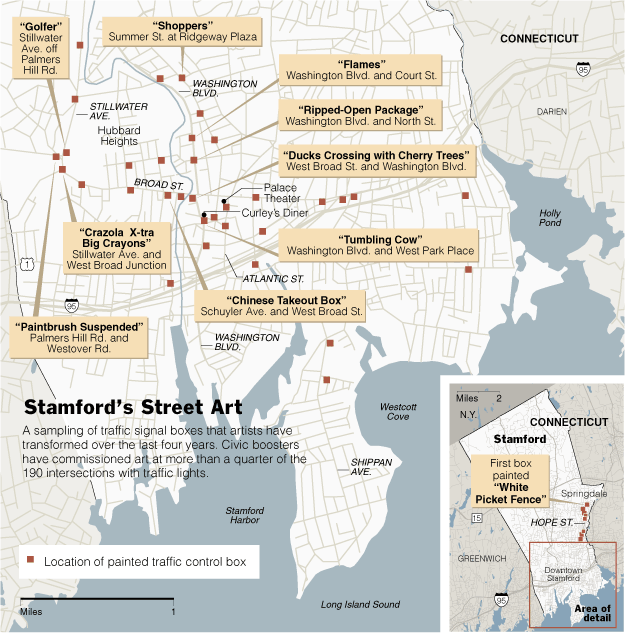
Stamford art on traffic boxes
NYTimes
November 25, 2006
On Traffic-Signal Boxes, Art That Stops Traffic
By ALISON LEIGH COWAN
STAMFORD, Conn., Nov. 24 — A blown-up version of the green-and-yellow crayon box familiar from childhood sits by the Boys and Girls Club. Down the road is a white takeout carton that could feed the Chinese Army. The box outside the firehouse on Washington Boulevard appears to be aflame. And there is a half-painted picket fence on Palmers Hill Road, the brush hovering in midair as if Tom Sawyer himself had momentarily stepped away, with a sign warning, “wet paint.”
What began four years ago as a tiny, grass-roots experiment to beautify the unsightly boxes that control traffic signals around town has become an unexpectedly impressive public art collection, with head-turning installations cropping up constantly to transform drab streetscapes into outdoor galleries.
About 50 of the city’s 190 boxes, once covered with graffiti, are now suitable for framing.
“They appear overnight,” said Renée Kahn, a local preservationist and a fan. “One weekend you drive by and there’s nothing, and the next weekend it’s suddenly there.”
When civic boosters first asked local artists to paint the boxes, the results often looked like shrubs or faux stone walls. But the artists grew bolder and began to riff on Stamford’s pastimes and passions as more neighborhood groups began to commission the boxes, which are usually 58 inches tall, 44 inches wide and 27 inches deep.
Thus, bag-laden shoppers were soon spotted at a shopping center, knicker-clad golfers teed off near the links, and a pigtailed girl scribbled on a chalkboard filled with equations outside an elementary school.
Two must-sees, resembling Pop Art at its wackiest, popped up in recent weeks. They give anyone stuck in traffic along Broad Street much to look at — too much, perhaps, if traffic suddenly starts moving. That crayon box, with the legend “Crazola,” holds an assortment of “X-tra Big” crayons. And the fine print on the oversize takeout carton, paying homage to a nearby Chinese restaurant, says, “No msg.”
“They make you smile,” said Sandy Goldstein, who as head of a downtown business group enlisted artists to decorate a dozen boxes in and around the central business district.
Most of the boxes in Ms. Goldstein’s collection, which received an award last year from the International Downtown Association, were the work of Zora Janosova, a former set designer for the Palace Theater. Ms. Janosova carried an oxygen tank with her as she scrambled to complete several boxes around town before her death last year from breast cancer at age 33.
On one she left behind near Curley’s Diner, a cow tumbles mysteriously from the sky, and on another, over by the Palace Theater, silhouetted heads ring the bottom, giving the audience on the street a figurative glimpse of the audience inside.
There is a range of motifs and styles on display around town. Springdale, a residential neighborhood in the northeast part of town, is dominated by Anne Salthouse’s subdued pastoral scenes. Hubbard Heights, a neighborhood of older homes, looks as if Andy Warhol or Claes Oldenburg moved in.
The Hubbard Heights Garden Club fell in love with the idea of commissioning boxes to beautify the streets because, as one 87-year-old member explained, she and the others were getting to the age where they were “a little beyond digging.”
The club hired Liz Squillace, 29, a graduate of the Rhode Island School of Design who lives in Greenwich, to do 20 boxes. Among her works are the crayons, the Chinese takeout, the flames outside the firehouse, and another on Washington Boulevard that looks like a carton whose contents are spilling out. Stamped on the outside are warnings like “handle with care.”
Looking back, civic boosters say they never set out to create public art on a grand scale. But in wrestling with what to do with the large boxes that had become graffiti magnets, they knew that hiding them was not possible.
Joseph Andrews, Stamford’s traffic signal supervisor, said that special turning lanes and signal synchronization had made suburban traffic boxes more complex; the electronics need to be above ground, he said, for ventilation and other reasons. In New York and other cities, Mr. Andrews said, signal boxes are usually smaller and hang on poles, while the newfangled ones here in Stamford are equipped with sensors that count the cars and adjust accordingly.
By most accounts, the first painted box here appeared, circa 2003, at Bouton and Hope Streets, in the form of whimsical trompe l’oeil blossoms sprouting along a classic picket fence. Marilyn Trefry, president of the Springdale Neighborhood Association, had hired Ms. Salthouse, a local artist, to do a few boxes, with the proviso that they had to “melt into the background,” according to Ms. Trefry.
Before work could begin, however, Ms. Trefry had to get permission from the city, which owns the boxes. Officials worried that dark colors absorb sunlight, and that the resulting heat could throw off the electronics. They warned the artists and neighborhood groups that if the boxes were hit by cars, too bad — the city would not pay to have the art replaced or repaired.
Finally, Ms. Trefry recalled, “the city was worried that if we did it, everybody else in town would want to, and they were right.”
Eventually, the city not only signed off on the idea, but also helped get grant money that the neighborhood groups have used to pay the artists, who generally get a few hundred dollars per box.
The boxes also seem to have won the approval of graffiti scrawlers, who have generally left the painted boxes alone. Civic groups and the police both interpret that hands-off response as a sign that the work has earned the respect of those who fancy themselves street artists.
At least four of the decorated boxes have been done in by wayward cars, just as city officials feared. Some of those now sit in a makeshift graveyard outside Mr. Andrews’s office until he figures out what to do with them.
Another casualty awaits replacement at the corner of Greyrock Place and Broad Street. It is a Janosova original, with painted caryatids that look as if they may crumple from the stress. The dents and dings are rusty rebukes to those who wish they had made time to see the piece in its better days, a reminder that this is one art show with an uncertain closing date.
Ms. Goldstein, the downtown business booster, said there are no plans as yet to offer tours of the collection, but said she would look into creating an official map. John Ruotolo, her operations director, joked that someone should “start selling maps to the signal boxes, the way they sell maps to the stars’ houses.”
Wednesday, November 08, 2006
Slow prep bread technique
NYTimes
November 8, 2006
The Minimalist
The Secret of Great Bread: Let Time Do the Work
By MARK BITTMAN
INNOVATIONS in bread baking are rare. In fact, the 6,000-year-old process hasn’t changed much since Pasteur made the commercial production of standardized yeast possible in 1859. The introduction of the gas stove, the electric mixer and the food processor made the process easier, faster and more reliable.
I’m not counting sliced bread as a positive step, but Jim Lahey’s method may be the greatest thing since.
This story began in late September when Mr. Lahey sent an e-mail message inviting me to attend a session of a class he was giving at Sullivan Street Bakery, which he owns, at 533 West 47th Street in Manhattan. His wording was irresistible: “I’ll be teaching a truly minimalist breadmaking technique that allows people to make excellent bread at home with very little effort. The method is surprisingly simple — I think a 4-year-old could master it — and the results are fantastic.”
I set up a time to visit Mr. Lahey, and we baked together, and the only bad news is that you cannot put your 4-year-old to work producing bread for you. The method is complicated enough that you would need a very ambitious 8-year-old. But the results are indeed fantastic.
Mr. Lahey’s method is striking on several levels. It requires no kneading. (Repeat: none.) It uses no special ingredients, equipment or techniques. It takes very little effort.
It accomplishes all of this by combining a number of unusual though not unheard of features. Most notable is that you’ll need about 24 hours to create a loaf; time does almost all the work. Mr. Lahey’s dough uses very little yeast, a quarter teaspoon (you almost never see a recipe with less than a teaspoon), and he compensates for this tiny amount by fermenting the dough very slowly. He mixes a very wet dough, about 42 percent water, which is at the extreme high end of the range that professional bakers use to create crisp crust and large, well-structured crumb, both of which are evident in this loaf.
The dough is so sticky that you couldn’t knead it if you wanted to. It is mixed in less than a minute, then sits in a covered bowl, undisturbed, for about 18 hours. It is then turned out onto a board for 15 minutes, quickly shaped (I mean in 30 seconds), and allowed to rise again, for a couple of hours. Then it’s baked. That’s it.
I asked Harold McGee, who is an amateur breadmaker and best known as the author of “On Food and Cooking” (Scribner, 2004), what he thought of this method. His response: “It makes sense. The long, slow rise does over hours what intensive kneading does in minutes: it brings the gluten molecules into side-by-side alignment to maximize their opportunity to bind to each other and produce a strong, elastic network. The wetness of the dough is an important piece of this because the gluten molecules are more mobile in a high proportion of water, and so can move into alignment easier and faster than if the dough were stiff.”
That’s as technical an explanation as I care to have, enough to validate what I already knew: Mr. Lahey’s method is creative and smart.
But until this point, it’s not revolutionary. Mr. McGee said he had been kneading less and less as the years have gone by, relying on time to do the work for him. Charles Van Over, author of the authoritative book on food-processor dough making, “The Best Bread Ever” (Broadway, 1997), long ago taught me to make a very wet dough (the food processor is great at this) and let it rise slowly. And, as Mr. Lahey himself notes, “The Egyptians mixed their batches of dough with a hoe.”
What makes Mr. Lahey’s process revolutionary is the resulting combination of great crumb, lightness, incredible flavor — long fermentation gives you that — and an enviable, crackling crust, the feature of bread that most frequently separates the amateurs from the pros. My bread has often had thick, hard crusts, not at all bad, but not the kind that shatter when you bite into them. Producing those has been a bane of the amateur for years, because it requires getting moisture onto the bread as the crust develops.
To get that kind of a crust, professionals use steam-injected ovens. At home I have tried brushing the dough with water (a hassle and ineffective); spraying it (almost as ineffective and requiring frequent attention); throwing ice cubes on the floor of the oven (not good for the oven, and not far from ineffective); and filling a pot with stones and preheating it, then pouring boiling water over the stones to create a wet sauna (quite effective but dangerous, physically challenging and space-consuming). I was discouraged from using La Cloche, a covered stoneware dish, by my long-standing disinclination to crowd my kitchen with inessential items that accomplish only one chore. I was discouraged from buying a $5,000 steam-injected oven by its price.
It turns out there’s no need for any of this. Mr. Lahey solves the problem by putting the dough in a preheated covered pot — a common one, a heavy one, but nothing fancy. For one loaf he used an old Le Creuset enameled cast iron pot; for another, a heavy ceramic pot. (I have used cast iron with great success.) By starting this very wet dough in a hot, covered pot, Mr. Lahey lets the crust develop in a moist, enclosed environment. The pot is in effect the oven, and that oven has plenty of steam in it. Once uncovered, a half-hour later, the crust has time to harden and brown, still in the pot, and the bread is done. (Fear not. The dough does not stick to the pot any more than it would to a preheated bread stone.)
The entire process is incredibly simple, and, in the three weeks I’ve been using it, absolutely reliable. Though professional bakers work with consistent flour, water, yeast and temperatures, and measure by weight, we amateurs have mostly inconsistent ingredients and measure by volume, which can make things unpredictable. Mr. Lahey thinks imprecision isn’t much of a handicap and, indeed, his method seems to iron out the wrinkles: “I encourage a somewhat careless approach,” he says, “and figure this may even be a disappointment to those who expect something more difficult. The proof is in the loaf.”
The loaf is incredible, a fine-bakery quality, European-style boule that is produced more easily than by any other technique I’ve used, and will blow your mind. (It may yet change the industry. Mr. Lahey is experimenting with using it on a large scale, but although it requires far less electricity than conventional baking, it takes a lot of space and time.) It is best made with bread flour, but all-purpose flour works fine. (I’ve played with whole-wheat and rye flours, too; the results are fantastic.)
You or your 8-year-old may hit this perfectly on the first try, or you may not. Judgment is involved; with practice you’ll get it right every time.
The baking itself is virtually foolproof, so the most important aspect is patience. Long, slow fermentation is critical. Mr. Lahey puts the time at 12 to 18 hours, but I have had much greater success at the longer time. If you are in a hurry, more yeast (three-eighths of a teaspoon) or a warmer room temperature may move things along, but really, once you’re waiting 12 hours why not wait 18? Similarly, Mr. Lahey’s second rising can take as little as an hour, but two hours, or even a little longer, works better.
Although even my “failed” loaves were as good as those from most bakeries, to make the loaf really sensational requires a bit of a commitment. But with just a little patience, you will be rewarded with the best no-work bread you have ever made. And that’s no small thing.
Recipe: No-Knead Bread
Adapted from Jim Lahey, Sullivan Street Bakery
Time: About 1½ hours plus 14 to 20 hours’ rising
3 cups all-purpose or bread flour, more for dusting
¼ teaspoon instant yeast
1¼ teaspoons salt
Cornmeal or wheat bran as needed.
1. In a large bowl combine flour, yeast and salt. Add 1 5/8 cups water, and stir until blended; dough will be shaggy and sticky. Cover bowl with plastic wrap. Let dough rest at least 12 hours, preferably about 18, at warm room temperature, about 70 degrees.
2. Dough is ready when its surface is dotted with bubbles. Lightly flour a work surface and place dough on it; sprinkle it with a little more flour and fold it over on itself once or twice. Cover loosely with plastic wrap and let rest about 15 minutes.
3. Using just enough flour to keep dough from sticking to work surface or to your fingers, gently and quickly shape dough into a ball. Generously coat a cotton towel (not terry cloth) with flour, wheat bran or cornmeal; put dough seam side down on towel and dust with more flour, bran or cornmeal. Cover with another cotton towel and let rise for about 2 hours. When it is ready, dough will be more than double in size and will not readily spring back when poked with a finger.
4. At least a half-hour before dough is ready, heat oven to 450 degrees. Put a 6- to 8-quart heavy covered pot (cast iron, enamel, Pyrex or ceramic) in oven as it heats. When dough is ready, carefully remove pot from oven. Slide your hand under towel and turn dough over into pot, seam side up; it may look like a mess, but that is O.K. Shake pan once or twice if dough is unevenly distributed; it will straighten out as it bakes. Cover with lid and bake 30 minutes, then remove lid and bake another 15 to 30 minutes, until loaf is beautifully browned. Cool on a rack.
Yield: One 1½-pound loaf.
LAST month I wrote about Jim Lahey, the owner of Sullivan Street Bakery on West 47th Street in Manhattan, and his clever way to produce a European-style boule at home. Mr. Lahey’s recipe calls for very little yeast, a wet dough, long rising times and baking in a closed, preheated pot. My results with Mr. Lahey’s method have been beyond satisfying.
Happily, so have those of most readers. In the last few weeks Jim Lahey’s recipe has been translated into German, baked in Togo, discussed on more than 200 blogs and written about in other newspapers. It has changed the lives (their words, not mine) of veteran and novice bakers. It has also generated enough questions to warrant further discussion here. The topics are more or less in the order of the quantity of inquiries.
WEIGHT VS. VOLUME The original recipe contained volume measures, but for those who prefer to use weight, here are the measurements: 430 grams of flour, 345 grams of water, 1 gram of yeast and 8 grams of salt. With experience, many people will stop measuring altogether and add just enough water to make the dough almost too wet to handle.
SALT Many people, me included, felt Mr. Lahey’s bread was not salty enough. Yes, you can use more salt and it won’t significantly affect the rising time. I’ve settled at just under a tablespoon.
YEAST Instant yeast, called for in the recipe, is also called rapid-rise yeast. But you can use whatever yeast you like. Active dry yeast can be used without proofing (soaking it to make sure it’s active).
TIMING About 18 hours is the preferred initial rising time. Some readers have cut this to as little as eight hours and reported little difference. I have not had much luck with shorter times, but I have gone nearly 24 hours without a problem. Room temperature will affect the rising time, and so will the temperature of the water you add (I start with tepid). Like many other people, I’m eager to see what effect warmer weather will have. But to those who have moved the rising dough around the room trying to find the 70-degree sweet spot: please stop. Any normal room temperature is fine. Just wait until you see bubbles and well-developed gluten — the long strands that cling to the sides of the bowl when you tilt it — before proceeding.
THE SECOND RISE Mr. Lahey originally suggested one to two hours, but two to three is more like it, in my experience. (Ambient temperatures in the summer will probably knock this time down some.) Some readers almost entirely skipped this rise, shaping the dough after the first rise and letting it rest while the pot and oven preheat; this is worth trying, of course.
OTHER FLOURS Up to 30 percent whole-grain flour works consistently and well, and 50 percent whole-wheat is also excellent. At least one reader used 100 percent whole-wheat and reported “great crust but somewhat inferior crumb,” which sounds promising. I’ve kept rye, which is delicious but notoriously impossible to get to rise, to about 20 percent. There is room to experiment.
FLAVORINGS The best time to add caraway seeds, chopped olives, onions, cheese, walnuts, raisins or whatever other traditional bread flavorings you like is after you’ve mixed the dough. But it’s not the only time; you can fold in ingredients before the second rising.
OTHER SHAPES Baguettes in fish steamers, rolls in muffin tins or classic loaves in loaf pans: if you can imagine it, and stay roughly within the pattern, it will work.
COVERING BETWEEN RISES A Silpat mat under the dough is a clever idea (not mine). Plastic wrap can be used as a top layer in place of a second towel.
THE POT The size matters, but not much. I have settled on a smaller pot than Mr. Lahey has, about three or four quarts. This produces a higher loaf, which many people prefer — again, me included. I’m using cast iron. Readers have reported success with just about every available material. Note that the lid handles on Le Creuset pots can only withstand temperatures up to 400 degrees. So avoid using them, or remove the handle first.
BAKING You can increase the initial temperature to 500 degrees for more rapid browning, but be careful; I scorched a loaf containing whole-wheat flour by doing this. Yes, you can reduce the length of time the pot is covered to 20 minutes from 30, and then increase the time the loaf bakes uncovered. Most people have had a good experience baking for an additional 30 minutes once the pot is uncovered.
As these answers demonstrate, almost everything about Mr. Lahey’s bread is flexible, within limits. As we experiment, we will have failures. (Like the time I stopped adding flour because the phone rang, and didn’t realize it until 18 hours later. Even this, however, was reparable). This method is going to have people experimenting, and largely succeeding, until something better comes along. It may be quite a while.
November 8, 2006
The Minimalist
The Secret of Great Bread: Let Time Do the Work
By MARK BITTMAN
INNOVATIONS in bread baking are rare. In fact, the 6,000-year-old process hasn’t changed much since Pasteur made the commercial production of standardized yeast possible in 1859. The introduction of the gas stove, the electric mixer and the food processor made the process easier, faster and more reliable.
I’m not counting sliced bread as a positive step, but Jim Lahey’s method may be the greatest thing since.
This story began in late September when Mr. Lahey sent an e-mail message inviting me to attend a session of a class he was giving at Sullivan Street Bakery, which he owns, at 533 West 47th Street in Manhattan. His wording was irresistible: “I’ll be teaching a truly minimalist breadmaking technique that allows people to make excellent bread at home with very little effort. The method is surprisingly simple — I think a 4-year-old could master it — and the results are fantastic.”
I set up a time to visit Mr. Lahey, and we baked together, and the only bad news is that you cannot put your 4-year-old to work producing bread for you. The method is complicated enough that you would need a very ambitious 8-year-old. But the results are indeed fantastic.
Mr. Lahey’s method is striking on several levels. It requires no kneading. (Repeat: none.) It uses no special ingredients, equipment or techniques. It takes very little effort.
It accomplishes all of this by combining a number of unusual though not unheard of features. Most notable is that you’ll need about 24 hours to create a loaf; time does almost all the work. Mr. Lahey’s dough uses very little yeast, a quarter teaspoon (you almost never see a recipe with less than a teaspoon), and he compensates for this tiny amount by fermenting the dough very slowly. He mixes a very wet dough, about 42 percent water, which is at the extreme high end of the range that professional bakers use to create crisp crust and large, well-structured crumb, both of which are evident in this loaf.
The dough is so sticky that you couldn’t knead it if you wanted to. It is mixed in less than a minute, then sits in a covered bowl, undisturbed, for about 18 hours. It is then turned out onto a board for 15 minutes, quickly shaped (I mean in 30 seconds), and allowed to rise again, for a couple of hours. Then it’s baked. That’s it.
I asked Harold McGee, who is an amateur breadmaker and best known as the author of “On Food and Cooking” (Scribner, 2004), what he thought of this method. His response: “It makes sense. The long, slow rise does over hours what intensive kneading does in minutes: it brings the gluten molecules into side-by-side alignment to maximize their opportunity to bind to each other and produce a strong, elastic network. The wetness of the dough is an important piece of this because the gluten molecules are more mobile in a high proportion of water, and so can move into alignment easier and faster than if the dough were stiff.”
That’s as technical an explanation as I care to have, enough to validate what I already knew: Mr. Lahey’s method is creative and smart.
But until this point, it’s not revolutionary. Mr. McGee said he had been kneading less and less as the years have gone by, relying on time to do the work for him. Charles Van Over, author of the authoritative book on food-processor dough making, “The Best Bread Ever” (Broadway, 1997), long ago taught me to make a very wet dough (the food processor is great at this) and let it rise slowly. And, as Mr. Lahey himself notes, “The Egyptians mixed their batches of dough with a hoe.”
What makes Mr. Lahey’s process revolutionary is the resulting combination of great crumb, lightness, incredible flavor — long fermentation gives you that — and an enviable, crackling crust, the feature of bread that most frequently separates the amateurs from the pros. My bread has often had thick, hard crusts, not at all bad, but not the kind that shatter when you bite into them. Producing those has been a bane of the amateur for years, because it requires getting moisture onto the bread as the crust develops.
To get that kind of a crust, professionals use steam-injected ovens. At home I have tried brushing the dough with water (a hassle and ineffective); spraying it (almost as ineffective and requiring frequent attention); throwing ice cubes on the floor of the oven (not good for the oven, and not far from ineffective); and filling a pot with stones and preheating it, then pouring boiling water over the stones to create a wet sauna (quite effective but dangerous, physically challenging and space-consuming). I was discouraged from using La Cloche, a covered stoneware dish, by my long-standing disinclination to crowd my kitchen with inessential items that accomplish only one chore. I was discouraged from buying a $5,000 steam-injected oven by its price.
It turns out there’s no need for any of this. Mr. Lahey solves the problem by putting the dough in a preheated covered pot — a common one, a heavy one, but nothing fancy. For one loaf he used an old Le Creuset enameled cast iron pot; for another, a heavy ceramic pot. (I have used cast iron with great success.) By starting this very wet dough in a hot, covered pot, Mr. Lahey lets the crust develop in a moist, enclosed environment. The pot is in effect the oven, and that oven has plenty of steam in it. Once uncovered, a half-hour later, the crust has time to harden and brown, still in the pot, and the bread is done. (Fear not. The dough does not stick to the pot any more than it would to a preheated bread stone.)
The entire process is incredibly simple, and, in the three weeks I’ve been using it, absolutely reliable. Though professional bakers work with consistent flour, water, yeast and temperatures, and measure by weight, we amateurs have mostly inconsistent ingredients and measure by volume, which can make things unpredictable. Mr. Lahey thinks imprecision isn’t much of a handicap and, indeed, his method seems to iron out the wrinkles: “I encourage a somewhat careless approach,” he says, “and figure this may even be a disappointment to those who expect something more difficult. The proof is in the loaf.”
The loaf is incredible, a fine-bakery quality, European-style boule that is produced more easily than by any other technique I’ve used, and will blow your mind. (It may yet change the industry. Mr. Lahey is experimenting with using it on a large scale, but although it requires far less electricity than conventional baking, it takes a lot of space and time.) It is best made with bread flour, but all-purpose flour works fine. (I’ve played with whole-wheat and rye flours, too; the results are fantastic.)
You or your 8-year-old may hit this perfectly on the first try, or you may not. Judgment is involved; with practice you’ll get it right every time.
The baking itself is virtually foolproof, so the most important aspect is patience. Long, slow fermentation is critical. Mr. Lahey puts the time at 12 to 18 hours, but I have had much greater success at the longer time. If you are in a hurry, more yeast (three-eighths of a teaspoon) or a warmer room temperature may move things along, but really, once you’re waiting 12 hours why not wait 18? Similarly, Mr. Lahey’s second rising can take as little as an hour, but two hours, or even a little longer, works better.
Although even my “failed” loaves were as good as those from most bakeries, to make the loaf really sensational requires a bit of a commitment. But with just a little patience, you will be rewarded with the best no-work bread you have ever made. And that’s no small thing.
Recipe: No-Knead Bread
Adapted from Jim Lahey, Sullivan Street Bakery
Time: About 1½ hours plus 14 to 20 hours’ rising
3 cups all-purpose or bread flour, more for dusting
¼ teaspoon instant yeast
1¼ teaspoons salt
Cornmeal or wheat bran as needed.
1. In a large bowl combine flour, yeast and salt. Add 1 5/8 cups water, and stir until blended; dough will be shaggy and sticky. Cover bowl with plastic wrap. Let dough rest at least 12 hours, preferably about 18, at warm room temperature, about 70 degrees.
2. Dough is ready when its surface is dotted with bubbles. Lightly flour a work surface and place dough on it; sprinkle it with a little more flour and fold it over on itself once or twice. Cover loosely with plastic wrap and let rest about 15 minutes.
3. Using just enough flour to keep dough from sticking to work surface or to your fingers, gently and quickly shape dough into a ball. Generously coat a cotton towel (not terry cloth) with flour, wheat bran or cornmeal; put dough seam side down on towel and dust with more flour, bran or cornmeal. Cover with another cotton towel and let rise for about 2 hours. When it is ready, dough will be more than double in size and will not readily spring back when poked with a finger.
4. At least a half-hour before dough is ready, heat oven to 450 degrees. Put a 6- to 8-quart heavy covered pot (cast iron, enamel, Pyrex or ceramic) in oven as it heats. When dough is ready, carefully remove pot from oven. Slide your hand under towel and turn dough over into pot, seam side up; it may look like a mess, but that is O.K. Shake pan once or twice if dough is unevenly distributed; it will straighten out as it bakes. Cover with lid and bake 30 minutes, then remove lid and bake another 15 to 30 minutes, until loaf is beautifully browned. Cool on a rack.
Yield: One 1½-pound loaf.
LAST month I wrote about Jim Lahey, the owner of Sullivan Street Bakery on West 47th Street in Manhattan, and his clever way to produce a European-style boule at home. Mr. Lahey’s recipe calls for very little yeast, a wet dough, long rising times and baking in a closed, preheated pot. My results with Mr. Lahey’s method have been beyond satisfying.
Happily, so have those of most readers. In the last few weeks Jim Lahey’s recipe has been translated into German, baked in Togo, discussed on more than 200 blogs and written about in other newspapers. It has changed the lives (their words, not mine) of veteran and novice bakers. It has also generated enough questions to warrant further discussion here. The topics are more or less in the order of the quantity of inquiries.
WEIGHT VS. VOLUME The original recipe contained volume measures, but for those who prefer to use weight, here are the measurements: 430 grams of flour, 345 grams of water, 1 gram of yeast and 8 grams of salt. With experience, many people will stop measuring altogether and add just enough water to make the dough almost too wet to handle.
SALT Many people, me included, felt Mr. Lahey’s bread was not salty enough. Yes, you can use more salt and it won’t significantly affect the rising time. I’ve settled at just under a tablespoon.
YEAST Instant yeast, called for in the recipe, is also called rapid-rise yeast. But you can use whatever yeast you like. Active dry yeast can be used without proofing (soaking it to make sure it’s active).
TIMING About 18 hours is the preferred initial rising time. Some readers have cut this to as little as eight hours and reported little difference. I have not had much luck with shorter times, but I have gone nearly 24 hours without a problem. Room temperature will affect the rising time, and so will the temperature of the water you add (I start with tepid). Like many other people, I’m eager to see what effect warmer weather will have. But to those who have moved the rising dough around the room trying to find the 70-degree sweet spot: please stop. Any normal room temperature is fine. Just wait until you see bubbles and well-developed gluten — the long strands that cling to the sides of the bowl when you tilt it — before proceeding.
THE SECOND RISE Mr. Lahey originally suggested one to two hours, but two to three is more like it, in my experience. (Ambient temperatures in the summer will probably knock this time down some.) Some readers almost entirely skipped this rise, shaping the dough after the first rise and letting it rest while the pot and oven preheat; this is worth trying, of course.
OTHER FLOURS Up to 30 percent whole-grain flour works consistently and well, and 50 percent whole-wheat is also excellent. At least one reader used 100 percent whole-wheat and reported “great crust but somewhat inferior crumb,” which sounds promising. I’ve kept rye, which is delicious but notoriously impossible to get to rise, to about 20 percent. There is room to experiment.
FLAVORINGS The best time to add caraway seeds, chopped olives, onions, cheese, walnuts, raisins or whatever other traditional bread flavorings you like is after you’ve mixed the dough. But it’s not the only time; you can fold in ingredients before the second rising.
OTHER SHAPES Baguettes in fish steamers, rolls in muffin tins or classic loaves in loaf pans: if you can imagine it, and stay roughly within the pattern, it will work.
COVERING BETWEEN RISES A Silpat mat under the dough is a clever idea (not mine). Plastic wrap can be used as a top layer in place of a second towel.
THE POT The size matters, but not much. I have settled on a smaller pot than Mr. Lahey has, about three or four quarts. This produces a higher loaf, which many people prefer — again, me included. I’m using cast iron. Readers have reported success with just about every available material. Note that the lid handles on Le Creuset pots can only withstand temperatures up to 400 degrees. So avoid using them, or remove the handle first.
BAKING You can increase the initial temperature to 500 degrees for more rapid browning, but be careful; I scorched a loaf containing whole-wheat flour by doing this. Yes, you can reduce the length of time the pot is covered to 20 minutes from 30, and then increase the time the loaf bakes uncovered. Most people have had a good experience baking for an additional 30 minutes once the pot is uncovered.
As these answers demonstrate, almost everything about Mr. Lahey’s bread is flexible, within limits. As we experiment, we will have failures. (Like the time I stopped adding flour because the phone rang, and didn’t realize it until 18 hours later. Even this, however, was reparable). This method is going to have people experimenting, and largely succeeding, until something better comes along. It may be quite a while.
Baking Tasty Turkey
NYTimes
November 8, 2006
As Six Turkeys Tussle for a Title, Degrees Challenge Pedigrees
By MARIAN BURROS
SOME of the greatest discoveries are inadvertent. Columbus sailed for China and landed in the Bahamas. And while a turkey taste test by the Dining section took us on a far shorter voyage, at least we stayed on course — and learned something more significant than what we set out to find.
In two experiments, we roasted six kinds of turkey: Bourbon Red and American Bronze, both heritage birds; farmed “wild” turkeys; the common broad-breasted whites, one raised organically and one bearing the “natural” label; and finally a Butterball, the national best seller. We wanted to see if the wild turkeys and heritage breeds, reintroduced to the American public in 2002, were worth the premium price.
In the end we concluded that temperature is nearly as important as breed. When most turkeys are properly cooked, the differences diminish.
Anyone who wants a flavorful, juicy main course this Thanksgiving can dispense with the brining pail, the cheesecloth and the propane-fueled deep-fryer. The only necessities are a properly calibrated oven, a basting brush, some aluminum foil and an instant-read digital thermometer.
And, crucially, the will to ignore the Agriculture Department’s advice to cook the bird until dry as dust or risk poisoning all your guests.
Every November the battle over turkey roasting is joined: the Agriculture Department insists that the temperature between the thigh and the breast should be 165 to 180 degrees (the department has given different advice in different places), but professional chefs scoff, saying that’s a guaranteed formula for dryness and for a texture that crumbles like plaster.
The government’s advice about harmful bacteria in poultry parallels its suggestion for ground beef: cook it until everything is killed, including the taste. The chances of running into harmful bacteria in both poultry and red meat are reduced if the animals have not been raised in confinement, but instead on pasture, as are all the premium turkeys.
Most nervous cooks take the government’s advice, making quarts of gravy and cranberry sauce not just an option but a necessity.
Caught between these irreconcilable differences, over the years I have finessed the thermometer and simply cut into the thigh to see if the juices run clear instead of pink. My turkeys have been moist and flavorful, and no guests have been harmed yet. (If any of your guests are elderly, children or women who are pregnant, or if their immune systems are compromised, err on the side of caution and return their servings to the oven till they reach an internal temperature of 165 degrees.)
In a first taste test more than half the birds were inadvertently overcooked (prompting someone to say that they were probably closest to what most people get on Thanksgiving).
Despite that, two things stood out in a blind tasting. The Butterball, though not overcooked, was tasteless. It was juicy because it was injected with broth and salt (not butter, as the name implies). The Bourbon Red heritage turkey, from a limited supply at Blue Hill at Stone Barns, and the American Bronze heritage turkey from D’Artagnan, though cooked too long, had the best flavor.
In a second test, we cooked two heritage birds, a Bourbon Red and an American Bronze from Heritage Foods; a domesticated wild bird from Quattro Farm; an organic free-range broad-breasted white from D’Artagnan; and two naturally raised broad-breasted whites, one from Griggstown Quail Farm, the other from Eberly Poultry.
This time, with the help of a professional chef, the turkeys were cooked to a uniform 150 degrees, removed from the oven and then tented with foil and allowed to rest until they reached 160 degrees.
Dan Barber of Blue Hill and Peter Hoffman at Savoy follow similar procedures, cutting off the thighs before or after roasting and cooking them longer, since they are not quite done when the breast is.
When we were finished I would not have been ashamed to serve any of the following birds on Thanksgiving, though the heritage turkeys were still my favorites.
HERITAGE Both the white meat and the dark delivered the essence of old-fashioned turkeyness. The white was succulent; even the richer dark meat was tender. If this turkey were a wine, it would be a fine old red. The additional cost is considerable, but for a once-a-year treat I will spend extra for either a Bourbon Red or an American Bronze. Available from heritagefoodsusa.com for $119 for a bird weighing 8 to 10 pounds, shipping included, or from dartagnan.com for $71.50.
ORGANIC The D’Artagnan organic free-range turkey was moist; the white meat had a mild turkey flavor and a fine, firm texture, and the dark had deeper flavor and was slightly chewier. This would be a Beaujolais. At retail stores for $3.49 to $3.99 a pound.
NATURAL The turkeys from Griggstown Quail Farm and from Eberly were similar to the organic: tender and juicy. The white meat had the light turkey flavor that most Americans are used to. The dark meat was a bit richer. Griggstown turkeys are available from www.griggstownquailfarm.com; a turkey weighing 15 to 18 pounds costs $100.95. Whole Foods sells the Eberly for $3.69 to $3.99 a pound.
WILD These turkeys were a little disappointing: somewhat chewy, a little dry. To my surprise, the white meat was not bursting with turkeyness. The dark meat, however, was moist and had a nice gamey flavor. Maybe even 150 degrees was too high a temperature for such lean birds. The Quattro Farm birds are available at the farm’s stand at the Union Square Greenmarket on Saturdays, and on Wednesday, Nov. 22, for $5.79 a pound. The birds must be ordered in advance from (845) 635-8202, and are available now. Quattro birds are also sold through dartagnan.com, where one weighing 8 to 10 pounds costs $71.50.
November 8, 2006
As Six Turkeys Tussle for a Title, Degrees Challenge Pedigrees
By MARIAN BURROS
SOME of the greatest discoveries are inadvertent. Columbus sailed for China and landed in the Bahamas. And while a turkey taste test by the Dining section took us on a far shorter voyage, at least we stayed on course — and learned something more significant than what we set out to find.
In two experiments, we roasted six kinds of turkey: Bourbon Red and American Bronze, both heritage birds; farmed “wild” turkeys; the common broad-breasted whites, one raised organically and one bearing the “natural” label; and finally a Butterball, the national best seller. We wanted to see if the wild turkeys and heritage breeds, reintroduced to the American public in 2002, were worth the premium price.
In the end we concluded that temperature is nearly as important as breed. When most turkeys are properly cooked, the differences diminish.
Anyone who wants a flavorful, juicy main course this Thanksgiving can dispense with the brining pail, the cheesecloth and the propane-fueled deep-fryer. The only necessities are a properly calibrated oven, a basting brush, some aluminum foil and an instant-read digital thermometer.
And, crucially, the will to ignore the Agriculture Department’s advice to cook the bird until dry as dust or risk poisoning all your guests.
Every November the battle over turkey roasting is joined: the Agriculture Department insists that the temperature between the thigh and the breast should be 165 to 180 degrees (the department has given different advice in different places), but professional chefs scoff, saying that’s a guaranteed formula for dryness and for a texture that crumbles like plaster.
The government’s advice about harmful bacteria in poultry parallels its suggestion for ground beef: cook it until everything is killed, including the taste. The chances of running into harmful bacteria in both poultry and red meat are reduced if the animals have not been raised in confinement, but instead on pasture, as are all the premium turkeys.
Most nervous cooks take the government’s advice, making quarts of gravy and cranberry sauce not just an option but a necessity.
Caught between these irreconcilable differences, over the years I have finessed the thermometer and simply cut into the thigh to see if the juices run clear instead of pink. My turkeys have been moist and flavorful, and no guests have been harmed yet. (If any of your guests are elderly, children or women who are pregnant, or if their immune systems are compromised, err on the side of caution and return their servings to the oven till they reach an internal temperature of 165 degrees.)
In a first taste test more than half the birds were inadvertently overcooked (prompting someone to say that they were probably closest to what most people get on Thanksgiving).
Despite that, two things stood out in a blind tasting. The Butterball, though not overcooked, was tasteless. It was juicy because it was injected with broth and salt (not butter, as the name implies). The Bourbon Red heritage turkey, from a limited supply at Blue Hill at Stone Barns, and the American Bronze heritage turkey from D’Artagnan, though cooked too long, had the best flavor.
In a second test, we cooked two heritage birds, a Bourbon Red and an American Bronze from Heritage Foods; a domesticated wild bird from Quattro Farm; an organic free-range broad-breasted white from D’Artagnan; and two naturally raised broad-breasted whites, one from Griggstown Quail Farm, the other from Eberly Poultry.
This time, with the help of a professional chef, the turkeys were cooked to a uniform 150 degrees, removed from the oven and then tented with foil and allowed to rest until they reached 160 degrees.
Dan Barber of Blue Hill and Peter Hoffman at Savoy follow similar procedures, cutting off the thighs before or after roasting and cooking them longer, since they are not quite done when the breast is.
When we were finished I would not have been ashamed to serve any of the following birds on Thanksgiving, though the heritage turkeys were still my favorites.
HERITAGE Both the white meat and the dark delivered the essence of old-fashioned turkeyness. The white was succulent; even the richer dark meat was tender. If this turkey were a wine, it would be a fine old red. The additional cost is considerable, but for a once-a-year treat I will spend extra for either a Bourbon Red or an American Bronze. Available from heritagefoodsusa.com for $119 for a bird weighing 8 to 10 pounds, shipping included, or from dartagnan.com for $71.50.
ORGANIC The D’Artagnan organic free-range turkey was moist; the white meat had a mild turkey flavor and a fine, firm texture, and the dark had deeper flavor and was slightly chewier. This would be a Beaujolais. At retail stores for $3.49 to $3.99 a pound.
NATURAL The turkeys from Griggstown Quail Farm and from Eberly were similar to the organic: tender and juicy. The white meat had the light turkey flavor that most Americans are used to. The dark meat was a bit richer. Griggstown turkeys are available from www.griggstownquailfarm.com; a turkey weighing 15 to 18 pounds costs $100.95. Whole Foods sells the Eberly for $3.69 to $3.99 a pound.
WILD These turkeys were a little disappointing: somewhat chewy, a little dry. To my surprise, the white meat was not bursting with turkeyness. The dark meat, however, was moist and had a nice gamey flavor. Maybe even 150 degrees was too high a temperature for such lean birds. The Quattro Farm birds are available at the farm’s stand at the Union Square Greenmarket on Saturdays, and on Wednesday, Nov. 22, for $5.79 a pound. The birds must be ordered in advance from (845) 635-8202, and are available now. Quattro birds are also sold through dartagnan.com, where one weighing 8 to 10 pounds costs $71.50.
Friday, November 03, 2006
Marathon factors
NYTimes
November 3, 2006
New York City Marathon
Everything You Know About Marathons Is Wrong
By GINA KOLATA
Most runners have heard the marathon lore: Your time will be best if the weather on race day is about 55 degrees and overcast, or even drizzly. And avoid dehydration at all costs, because it will cause your muscles to cramp and you could collapse at the finish line.
But none of that is true, researchers said at a recent marathon medicine and science conference in Chicago.
The weather theory “needs adjusting,” said Scott J. Montain, a research physiologist at the United States Army Research Institute of Environmental Medicine in Natick, Mass.
“Most of what we know comes from the lay literature,” he said.
Thousands of runners are no doubt monitoring the weather forecast for Sunday, when the New York City Marathon makes its annual tour of the five boroughs. (As of yesterday, it looked promising, with temperatures expected to be in the upper 40’s and partially cloudy skies.) But the weather nostrums for marathoning that are cited so authoritatively in journal articles and textbooks are not always borne out in legitimate science. Montain and his colleagues set out to conduct a proper study.
They gathered data from 28 years of the New York City Marathon, 35 years of the Boston Marathon and 23 years of the marathons in Hartford, Vancouver, Duluth, Minn., and Richmond, Va. The routes for those marathons have barely changed over the years, and each had a large field — more than 10,000 runners. The investigators looked at the average times for the top three men and women, and at the times for the runners who placed 25th, 50th, 100th and 300th.
Elite runners ran fastest in the coldest conditions — 41 to 50 degrees. But the slowing effect with heat was not as great as had been previously reported. For every five-degree increase in temperature, times slowed by 0.4 percent.
Warmer weather had a greater effect on slower runners. On a 77-degree day, an elite runner would be about 5 percent slower than on a 41-degree day. But a runner who finished in three hours on a 41-degree day would be slowed by about 12 percent on a 77-degree day, finishing in 3 hours 21 minutes.
One reason, Montain said, could be that slower runners spend more time on the course, and the temperature generally rises through the day. Or it could be because slower runners tend to run with a larger pack. A tightly clustered group of runners generates heat and blocks it from dissipating.
Montain and his colleagues also looked at whether marathon times were better under sunny or overcast skies. Only 13 percent of records were set on cool and cloudy days.
“It is more likely that a record will be set when it is sunny or when there are scattered clouds,” Montain said. He is not sure why that is; perhaps sunny conditions put runners in a better mood, he suggested.
Then there is the issue of cramping, that often excruciating, spasmodic, involuntary contraction of muscles that can occur during or, more often, just after a marathon. It almost always involves the muscles that were used to run — the hamstrings or calf muscles, for example. And it can last a minute or two — or much longer.
Conventional wisdom says cramps are caused by dehydration and that the solution is to consume salt and drink more fluids. Not true, says Martin P. Schwellnus, a professor of sports medicine at the University of Cape Town in South Africa.
At the conference in Chicago last month, he reported that he could find no relationship between dehydration and cramping. He has studied cyclists, marathoners and triathletes, measuring levels of electrolytes and body-weight changes, both of which are indicators of dehydration. Those who cramped were no different from those who did not.
Two other studies looked at how much weight ultramarathon runners and triathletes lost during races — a measure of fluid loss and a direct indicator of dehydration. Those who cramped lost no more weight than those who did not. If anything, Schwellnus said, those who did not have cramps were slightly more dehydrated.
The cause of cramps, Schwellnus believes, is an alteration in the electrical signals going to exhausted muscles so that the balance between those signals activating muscles and those inhibiting them is distorted. One way to protect yourself is with proper marathon training and proper pacing. “Racing at too high of an intensity is one of the single most important risk factors,” Schwellnus said.
When muscles cramp, there is a simple and effective treatment: stop running and stretch that muscle. And, Schwellnus said, realize that the cramping will soon stop.
“Almost no matter what you do, if you stop the activity, the muscle will come back to normal,” he said.
Beyond the finish line of every marathon are runners who feel dizzy, and some of them collapse. It is not as common as muscle cramps, but the condition can afflict up to about 5 percent of marathon runners, said Michael N. Sawka, head of the thermal and mountain medicine division at the United States Army Research Institute of Environmental Medicine. He wondered whether the cause could be dehydration, a commonly evoked mechanism.
Sawka looked at published studies. One compared 45 athletes who collapsed after an ultramarathon to 65 who completed the race and did not collapse. There were no obvious differences between the two groups: their body temperatures were the same (dehydration makes the temperature rise), as were their electrolyte levels. But those who collapsed were pushing themselves as hard as they could, were at or close to their personal records, or were medal winners in the race. Perhaps, Sawka said, “that final effort might contribute to collapse.”
The actual cause, though, does not appear to be dehydration, Sawka said. Instead, it is a pooling of blood in the lower legs and feet when vigorous exercise suddenly stops and the heart rate slows markedly.
Timothy Noakes, a professor of exercise and sports science at the University of Cape Town, said he had stopped giving intravenous fluids to collapsed runners.
“We completely changed the way we treat patients,” Noakes said. “All we do is have them lie down and put their feet higher than their head.”
Postmarathon collapse, Noakes added, “is a benign condition.”
“Just lift their legs and you will help the majority of patients,” he said. “That’s all you need to do to make most people recover very, very quickly. You can infuse as much fluid as you want, and you will not get the same response.”
November 3, 2006
New York City Marathon
Everything You Know About Marathons Is Wrong
By GINA KOLATA
Most runners have heard the marathon lore: Your time will be best if the weather on race day is about 55 degrees and overcast, or even drizzly. And avoid dehydration at all costs, because it will cause your muscles to cramp and you could collapse at the finish line.
But none of that is true, researchers said at a recent marathon medicine and science conference in Chicago.
The weather theory “needs adjusting,” said Scott J. Montain, a research physiologist at the United States Army Research Institute of Environmental Medicine in Natick, Mass.
“Most of what we know comes from the lay literature,” he said.
Thousands of runners are no doubt monitoring the weather forecast for Sunday, when the New York City Marathon makes its annual tour of the five boroughs. (As of yesterday, it looked promising, with temperatures expected to be in the upper 40’s and partially cloudy skies.) But the weather nostrums for marathoning that are cited so authoritatively in journal articles and textbooks are not always borne out in legitimate science. Montain and his colleagues set out to conduct a proper study.
They gathered data from 28 years of the New York City Marathon, 35 years of the Boston Marathon and 23 years of the marathons in Hartford, Vancouver, Duluth, Minn., and Richmond, Va. The routes for those marathons have barely changed over the years, and each had a large field — more than 10,000 runners. The investigators looked at the average times for the top three men and women, and at the times for the runners who placed 25th, 50th, 100th and 300th.
Elite runners ran fastest in the coldest conditions — 41 to 50 degrees. But the slowing effect with heat was not as great as had been previously reported. For every five-degree increase in temperature, times slowed by 0.4 percent.
Warmer weather had a greater effect on slower runners. On a 77-degree day, an elite runner would be about 5 percent slower than on a 41-degree day. But a runner who finished in three hours on a 41-degree day would be slowed by about 12 percent on a 77-degree day, finishing in 3 hours 21 minutes.
One reason, Montain said, could be that slower runners spend more time on the course, and the temperature generally rises through the day. Or it could be because slower runners tend to run with a larger pack. A tightly clustered group of runners generates heat and blocks it from dissipating.
Montain and his colleagues also looked at whether marathon times were better under sunny or overcast skies. Only 13 percent of records were set on cool and cloudy days.
“It is more likely that a record will be set when it is sunny or when there are scattered clouds,” Montain said. He is not sure why that is; perhaps sunny conditions put runners in a better mood, he suggested.
Then there is the issue of cramping, that often excruciating, spasmodic, involuntary contraction of muscles that can occur during or, more often, just after a marathon. It almost always involves the muscles that were used to run — the hamstrings or calf muscles, for example. And it can last a minute or two — or much longer.
Conventional wisdom says cramps are caused by dehydration and that the solution is to consume salt and drink more fluids. Not true, says Martin P. Schwellnus, a professor of sports medicine at the University of Cape Town in South Africa.
At the conference in Chicago last month, he reported that he could find no relationship between dehydration and cramping. He has studied cyclists, marathoners and triathletes, measuring levels of electrolytes and body-weight changes, both of which are indicators of dehydration. Those who cramped were no different from those who did not.
Two other studies looked at how much weight ultramarathon runners and triathletes lost during races — a measure of fluid loss and a direct indicator of dehydration. Those who cramped lost no more weight than those who did not. If anything, Schwellnus said, those who did not have cramps were slightly more dehydrated.
The cause of cramps, Schwellnus believes, is an alteration in the electrical signals going to exhausted muscles so that the balance between those signals activating muscles and those inhibiting them is distorted. One way to protect yourself is with proper marathon training and proper pacing. “Racing at too high of an intensity is one of the single most important risk factors,” Schwellnus said.
When muscles cramp, there is a simple and effective treatment: stop running and stretch that muscle. And, Schwellnus said, realize that the cramping will soon stop.
“Almost no matter what you do, if you stop the activity, the muscle will come back to normal,” he said.
Beyond the finish line of every marathon are runners who feel dizzy, and some of them collapse. It is not as common as muscle cramps, but the condition can afflict up to about 5 percent of marathon runners, said Michael N. Sawka, head of the thermal and mountain medicine division at the United States Army Research Institute of Environmental Medicine. He wondered whether the cause could be dehydration, a commonly evoked mechanism.
Sawka looked at published studies. One compared 45 athletes who collapsed after an ultramarathon to 65 who completed the race and did not collapse. There were no obvious differences between the two groups: their body temperatures were the same (dehydration makes the temperature rise), as were their electrolyte levels. But those who collapsed were pushing themselves as hard as they could, were at or close to their personal records, or were medal winners in the race. Perhaps, Sawka said, “that final effort might contribute to collapse.”
The actual cause, though, does not appear to be dehydration, Sawka said. Instead, it is a pooling of blood in the lower legs and feet when vigorous exercise suddenly stops and the heart rate slows markedly.
Timothy Noakes, a professor of exercise and sports science at the University of Cape Town, said he had stopped giving intravenous fluids to collapsed runners.
“We completely changed the way we treat patients,” Noakes said. “All we do is have them lie down and put their feet higher than their head.”
Postmarathon collapse, Noakes added, “is a benign condition.”
“Just lift their legs and you will help the majority of patients,” he said. “That’s all you need to do to make most people recover very, very quickly. You can infuse as much fluid as you want, and you will not get the same response.”
Wednesday, October 25, 2006
Cheaper for hospitals to provide free primary care than free emergency care
NYTimes
October 25, 2006
To Lower Costs, Hospitals Try Free Basic Care for Uninsured
By ERIK ECKHOLM
AUSTIN, Tex. — Unable to afford health insurance, Dee Dee Dodd had for years been mixing occasional doctor visits with clumsy efforts to self-manage her insulin-dependent diabetes, getting sicker all the while.
In one 18-month period, Ms. Dodd, 38, was rushed almost monthly to the emergency room, spent weeks in the intensive care unit and accumulated more than $191,000 in unpaid bills.
That is when nurses at the Seton Family of Hospitals tagged her as a “frequent flier,” a repeat visitor whose ailments — and expenses — might be curbed with more regular care. The hospital began offering her free primary care through its charity program.
With the number of uninsured Americans reaching a record 46.6 million last year, up by 7 million from 2000, Seton is one of a small number of hospital systems around the country to have done the math and acted on it. Officials decided that for many patients with chronic diseases, it would be cheaper to provide free preventive care than to absorb the high cost of repeated emergencies.
With patients like Ms. Dodd, “they can have better care and we can reduce the costs for the hospital,” said Dr. Melissa Smith, medical director of three community health centers run by Seton, a Roman Catholic hospital network that uses its profits and donations to provide nearly free care to 5,000 of the working poor. Over the last 18 months, Ms. Dodd’s health has improved, and her medical bills have been cut nearly in half.
Reaching out to uninsured patients, especially those with chronic conditions like diabetes, hypertension, congestive heart failure or asthma, is a recent tactic of “a handful of visionary hospital systems around the country,” said Karen Davis, president of the Commonwealth Fund, a foundation in New York that concentrates on health care. These institutions are searching for ways to fend off disease and large debts by bringing uninsured visitors into continuing basic care.
The public hospital systems in New York and Denver, for example, have both worked to steer uninsured patients to community clinics, charging modest fees, if any. New York’s public system, the Health and Hospitals Corporation, has assigned some 240,000 uninsured patients to personal primary care doctors. A computerized system tracks those with chronic conditions, and when necessary, social workers contact patients to make sure they get checkups and follow medical advice.
“For most preventive efforts there is an upfront expense,” said Alan D. Aviles, president of the corporation. “But over the long term it saves money.”
Denver’s public system, Denver Health, has 41,000 uninsured patients enrolled in its clinics. Officials there calculate that for every dollar they spend on prenatal care for uninsured women, they save more than $7 in newborn and child care.
The “safety net” plan of the Seton system in Central Texas accepts people making 150 percent to 250 percent of the federal poverty limit and has resources to support 5,000 patients. (People below the poverty line, which is $13,200 a year for a family of two in the contiguous states, can obtain care through the public clinic system.)
Officials scrutinize the records of plan members to see who is still overusing the emergency room or being repeatedly hospitalized — these high-cost patients total some 40 each month — then assign them caseworkers to help improve care and bring down costs.
A special effort to educate 631 asthma patients saved the plan $475,000 in one year, Seton officials said.
In a more unusual step, Seton officials also look for frequent emergency room users who do not qualify for the hospital’s charity plan because they live in a different county, like Ms. Dodd, or have incomes just above the threshold. In a dozen cases so far, all involving diabetics, a committee has judged that it makes financial sense to bring these people into the charity plan anyway and provide intensive support.
Other answers to the insurance crisis are being tried around the country, including the creation of subsidized, bare-bones policies for small businesses. Vermont, Maine and especially Massachusetts are using combinations of state and federal money and employer mandates to extend insurance.
Still, only a fraction of the uninsured, in Central Texas and in most other states, are benefiting.
“All these local efforts are commendable, but they are like sticking fingers in the dikes,” Ms. Davis of the Commonwealth Fund said, noting that the larger trend was hospitals’ seeking to avoid the uninsured.
Nowhere is the problem more acute than in Texas, where nearly a quarter of the population is uninsured, the nation’s highest rate. Small businesses here are unlikely to offer benefits, and the state government’s unusually stringent restrictions on Medicaid for adults leave many of the working poor at risk.
Even without counting the large immigrant population, Texas has the country’s highest share of uninsured, at 21 percent, according to the Center for Public Policy Priorities in Austin.
“All the hospitals here provide some uncompensated care, and they are eating it and passing the costs along to the payers,” said Patricia A. Young Brown, president of the Travis County Healthcare District, which was set up last year to oversee care of the indigent through public clinics, drawing on property taxes to pay.
“So insurance rates go up, and then more businesses drop insurance,” Ms. Young Brown continued, describing a trend unfolding nationwide. “It’s hard to see where it will end. We hear a cry for national and state leadership.”
The private People’s Community Clinic, supported in part by the St. David’s Hospital system, gives primary care to 11,000 people in Austin who are uninsured or on Medicaid and related programs.
“I think we are a good Band-Aid for those able to come to our clinic,” Regina Rogoff, director of the clinic, said. “But it’s not a solution to have such a ragtag, makeshift system.”
Austin hospitals and charity clinics have also joined in a pioneering data-sharing system to track visits by uninsured patients and fight unnecessary use of the emergency room. But rural counties in Texas offer little aid, and rural residents with serious maladies end up traveling to urban emergency rooms.
The current patchwork also pits different levels of government against each other.
Natavidad Martinez, 51, who used to work as a bookbinder for $7 an hour and never had insurance, has found herself in a bureaucratic nightmare.
In March 2005, Ms. Martinez, a Seton patient, was found to have liver cancer. She was put on Medicaid, applied for federal disability and was put in line for a liver transplant, without which, doctors said, she had six months to two years to live. Through the summer of 2005, she made the hour-and-a-half drive from her home to San Antonio for preparatory tests.
That August, she was awarded disability payments of $561 a month. But because her income surpassed the $535 limit for Medicaid in her circumstances, she said, she was told by the state that her coverage had ended, and the hospital said it could not proceed with a transplant.
“I asked Social Security if they couldn’t just reduce my payments by $30 a month,” she said, “but they said it doesn’t work that way.”
In another twist, by federal rules, she will qualify for Medicare two years after the initial finding of disability. She awaits the start of Medicare coverage next March, when she can rejoin the transplant line.
In Texas, as throughout the country, the coverage of poor children through Medicaid and related programs expanded greatly over the last decade. But a majority of states do not provide Medicaid to parents making even poverty-line incomes, and Texas is one of the least generous: here, a working parent of two does not qualify for coverage if he or she makes more than $3,696 in a year, leaving people like Ms. Dodd to fend for themselves.
Ms. Dodd, who worked as a dental assistant, is married to a truck driver, has four children and lives on a country road in Hays County, south of Austin. Ten years ago, after her weight fell to 82 pounds, she learned that she was a “brittle diabetic,” subject to rapid and dangerous changes in blood sugar. She saw a doctor only sporadically because visits cost $120 — money she did not have.
“I had to stop working, so then I couldn’t afford to go to the doctor, and then I had to go to the emergency room,” Ms. Dodd said.
She was having repeated episodes of ketoacidosis, a chemical imbalance that sometimes put her into life-threatening comas. Years of poor care had weakened her and led to side effects like esophogeal ulcers that could probably have been prevented, her doctors said.
Ms. Dodd still has problems, but the use of a $3,200 insulin pump paid for by Seton, which automatically adjusts her insulin levels, along with access to an endocrinologist and home counseling have reduced their severity. Her care in the last 18 months has cost Seton $104,697, far below the $191,277 for the previous period. More important, the later figures include less hospital time and more medicines and expert advice.
“The money we save,” Dr. Smith, of Seton, said, “money that is not hemorrhaging through the I.C.U., is money we can do so much more with to help her upfront.”
October 25, 2006
To Lower Costs, Hospitals Try Free Basic Care for Uninsured
By ERIK ECKHOLM
AUSTIN, Tex. — Unable to afford health insurance, Dee Dee Dodd had for years been mixing occasional doctor visits with clumsy efforts to self-manage her insulin-dependent diabetes, getting sicker all the while.
In one 18-month period, Ms. Dodd, 38, was rushed almost monthly to the emergency room, spent weeks in the intensive care unit and accumulated more than $191,000 in unpaid bills.
That is when nurses at the Seton Family of Hospitals tagged her as a “frequent flier,” a repeat visitor whose ailments — and expenses — might be curbed with more regular care. The hospital began offering her free primary care through its charity program.
With the number of uninsured Americans reaching a record 46.6 million last year, up by 7 million from 2000, Seton is one of a small number of hospital systems around the country to have done the math and acted on it. Officials decided that for many patients with chronic diseases, it would be cheaper to provide free preventive care than to absorb the high cost of repeated emergencies.
With patients like Ms. Dodd, “they can have better care and we can reduce the costs for the hospital,” said Dr. Melissa Smith, medical director of three community health centers run by Seton, a Roman Catholic hospital network that uses its profits and donations to provide nearly free care to 5,000 of the working poor. Over the last 18 months, Ms. Dodd’s health has improved, and her medical bills have been cut nearly in half.
Reaching out to uninsured patients, especially those with chronic conditions like diabetes, hypertension, congestive heart failure or asthma, is a recent tactic of “a handful of visionary hospital systems around the country,” said Karen Davis, president of the Commonwealth Fund, a foundation in New York that concentrates on health care. These institutions are searching for ways to fend off disease and large debts by bringing uninsured visitors into continuing basic care.
The public hospital systems in New York and Denver, for example, have both worked to steer uninsured patients to community clinics, charging modest fees, if any. New York’s public system, the Health and Hospitals Corporation, has assigned some 240,000 uninsured patients to personal primary care doctors. A computerized system tracks those with chronic conditions, and when necessary, social workers contact patients to make sure they get checkups and follow medical advice.
“For most preventive efforts there is an upfront expense,” said Alan D. Aviles, president of the corporation. “But over the long term it saves money.”
Denver’s public system, Denver Health, has 41,000 uninsured patients enrolled in its clinics. Officials there calculate that for every dollar they spend on prenatal care for uninsured women, they save more than $7 in newborn and child care.
The “safety net” plan of the Seton system in Central Texas accepts people making 150 percent to 250 percent of the federal poverty limit and has resources to support 5,000 patients. (People below the poverty line, which is $13,200 a year for a family of two in the contiguous states, can obtain care through the public clinic system.)
Officials scrutinize the records of plan members to see who is still overusing the emergency room or being repeatedly hospitalized — these high-cost patients total some 40 each month — then assign them caseworkers to help improve care and bring down costs.
A special effort to educate 631 asthma patients saved the plan $475,000 in one year, Seton officials said.
In a more unusual step, Seton officials also look for frequent emergency room users who do not qualify for the hospital’s charity plan because they live in a different county, like Ms. Dodd, or have incomes just above the threshold. In a dozen cases so far, all involving diabetics, a committee has judged that it makes financial sense to bring these people into the charity plan anyway and provide intensive support.
Other answers to the insurance crisis are being tried around the country, including the creation of subsidized, bare-bones policies for small businesses. Vermont, Maine and especially Massachusetts are using combinations of state and federal money and employer mandates to extend insurance.
Still, only a fraction of the uninsured, in Central Texas and in most other states, are benefiting.
“All these local efforts are commendable, but they are like sticking fingers in the dikes,” Ms. Davis of the Commonwealth Fund said, noting that the larger trend was hospitals’ seeking to avoid the uninsured.
Nowhere is the problem more acute than in Texas, where nearly a quarter of the population is uninsured, the nation’s highest rate. Small businesses here are unlikely to offer benefits, and the state government’s unusually stringent restrictions on Medicaid for adults leave many of the working poor at risk.
Even without counting the large immigrant population, Texas has the country’s highest share of uninsured, at 21 percent, according to the Center for Public Policy Priorities in Austin.
“All the hospitals here provide some uncompensated care, and they are eating it and passing the costs along to the payers,” said Patricia A. Young Brown, president of the Travis County Healthcare District, which was set up last year to oversee care of the indigent through public clinics, drawing on property taxes to pay.
“So insurance rates go up, and then more businesses drop insurance,” Ms. Young Brown continued, describing a trend unfolding nationwide. “It’s hard to see where it will end. We hear a cry for national and state leadership.”
The private People’s Community Clinic, supported in part by the St. David’s Hospital system, gives primary care to 11,000 people in Austin who are uninsured or on Medicaid and related programs.
“I think we are a good Band-Aid for those able to come to our clinic,” Regina Rogoff, director of the clinic, said. “But it’s not a solution to have such a ragtag, makeshift system.”
Austin hospitals and charity clinics have also joined in a pioneering data-sharing system to track visits by uninsured patients and fight unnecessary use of the emergency room. But rural counties in Texas offer little aid, and rural residents with serious maladies end up traveling to urban emergency rooms.
The current patchwork also pits different levels of government against each other.
Natavidad Martinez, 51, who used to work as a bookbinder for $7 an hour and never had insurance, has found herself in a bureaucratic nightmare.
In March 2005, Ms. Martinez, a Seton patient, was found to have liver cancer. She was put on Medicaid, applied for federal disability and was put in line for a liver transplant, without which, doctors said, she had six months to two years to live. Through the summer of 2005, she made the hour-and-a-half drive from her home to San Antonio for preparatory tests.
That August, she was awarded disability payments of $561 a month. But because her income surpassed the $535 limit for Medicaid in her circumstances, she said, she was told by the state that her coverage had ended, and the hospital said it could not proceed with a transplant.
“I asked Social Security if they couldn’t just reduce my payments by $30 a month,” she said, “but they said it doesn’t work that way.”
In another twist, by federal rules, she will qualify for Medicare two years after the initial finding of disability. She awaits the start of Medicare coverage next March, when she can rejoin the transplant line.
In Texas, as throughout the country, the coverage of poor children through Medicaid and related programs expanded greatly over the last decade. But a majority of states do not provide Medicaid to parents making even poverty-line incomes, and Texas is one of the least generous: here, a working parent of two does not qualify for coverage if he or she makes more than $3,696 in a year, leaving people like Ms. Dodd to fend for themselves.
Ms. Dodd, who worked as a dental assistant, is married to a truck driver, has four children and lives on a country road in Hays County, south of Austin. Ten years ago, after her weight fell to 82 pounds, she learned that she was a “brittle diabetic,” subject to rapid and dangerous changes in blood sugar. She saw a doctor only sporadically because visits cost $120 — money she did not have.
“I had to stop working, so then I couldn’t afford to go to the doctor, and then I had to go to the emergency room,” Ms. Dodd said.
She was having repeated episodes of ketoacidosis, a chemical imbalance that sometimes put her into life-threatening comas. Years of poor care had weakened her and led to side effects like esophogeal ulcers that could probably have been prevented, her doctors said.
Ms. Dodd still has problems, but the use of a $3,200 insulin pump paid for by Seton, which automatically adjusts her insulin levels, along with access to an endocrinologist and home counseling have reduced their severity. Her care in the last 18 months has cost Seton $104,697, far below the $191,277 for the previous period. More important, the later figures include less hospital time and more medicines and expert advice.
“The money we save,” Dr. Smith, of Seton, said, “money that is not hemorrhaging through the I.C.U., is money we can do so much more with to help her upfront.”
Tuesday, October 24, 2006
No-swipe credit card security risks
NYTimes
October 23, 2006
Researchers See Privacy Pitfalls in No-Swipe Credit Cards
By JOHN SCHWARTZ
AMHERST, Mass. — They call it the “Johnny Carson attack,” for his comic pose as a psychic divining the contents of an envelope.
Tom Heydt-Benjamin tapped an envelope against a black plastic box connected to his computer. Within moments, the screen showed a garbled string of characters that included this: fu/kevine, along with some numbers.
Mr. Heydt-Benjamin then ripped open the envelope. Inside was a credit card, fresh from the issuing bank. The card bore the name of Kevin E. Fu, a computer science professor at the University of Massachusetts, Amherst, who was standing nearby. The card number and expiration date matched those numbers on the screen.
The demonstration revealed potential security and privacy holes in a new generation of credit cards — cards whose data is relayed by radio waves without need of a signature or physical swiping through a machine. Tens of millions of the cards have been issued, and equipment for their use is showing up at a growing number of locations, including CVS pharmacies, McDonald’s restaurants and many movie theaters.
The card companies have implied through their marketing that the data is encrypted to make sure that a digital eavesdropper cannot get any intelligible information. American Express has said its cards incorporate “128-bit encryption,” and J. P. Morgan Chase has said that its cards, which it calls Blink, use “the highest level of encryption allowed by the U.S. government.”
But in tests on 20 cards from Visa, MasterCard and American Express, the researchers here found that the cardholder’s name and other data was being transmitted without encryption and in plain text. They could skim and store the information from a card with a device the size of a couple of paperback books, which they cobbled together from readily available computer and radio components for $150.
They say they could probably make another one even smaller and cheaper: about the size of a pack of gum for less than $50.
And because the cards can be read even through a wallet or an item of clothing, the security of the information, the researchers say, is startlingly weak. “Would you be comfortable wearing your name, your credit card number and your card expiration date on your T-shirt?” Mr. Heydt-Benjamin, a graduate student, asked.
Companies that make and issue the cards argue that what looks shocking in the lab could not lead to widespread abuse in the real world, and that additional data protection and antifraud measures in the payment system protect consumers from end to end.
“This is an interesting technical exercise,” said Brian Triplett, senior vice president for emerging-product development for Visa, “but as a real threat to a consumer — that threat really doesn’t exist.”
The finding comes at a time of strong suspicion among privacy advocates and consumer groups about the security of the underlying technology, called radio frequency identification, or RFID. Though the systems are designed to allow a card to be read only in close proximity, researchers have found that they can extend the distance.
The actual distance is still a matter of debate, but the claims range from several inches to many feet. And even the shortest distance could allow a would-be card skimmer to mill about in a crowded place and pull data from the wallets of passersby, or to collect data from envelopes sitting in mailboxes.
“No one’s going to look at me funny if I walk down the street and put a flier in everybody’s mailbox,” Mr. Heydt-Benjamin said.
The experiment was conducted by researchers here working with RSA Labs, a part of EMC, an information management and storage company. The resulting paper, which has been submitted to a computer security conference, is the first fruit of a new consortium of industry and academic researchers financed by the National Science Foundation to study RFID.
Security experts who were not involved in the research have praised the paper, and said that they were startled by the findings. Aviel D. Rubin, a professor of computer security at Johns Hopkins University, said, “There is a certain amount of privacy that consumers expect, and I believe that credit card companies have crossed the line.”
The companies, however, argue that testing just 20 cards does not provide an accurate picture of the card market, which generally uses higher security standards than the cards that were tested. “It’s a small sample,” said Art Kranzley, an executive with MasterCard. “This is almost akin to somebody standing up in the theater and yelling, ‘Fire!’ because somebody lit a cigarette.”
Chips like those used by the credit card companies can encrypt the data they send, but that can slow down transactions and make building and maintaining the payment networks more expensive. Other systems, including the Speedpass keychain device offered by Exxon Mobil, encrypt the transmission — though Exxon came under fire for using encryption that experts said was weak.
Though information on the cards may be transmitted in plain text, the company representatives argued, the process of making purchases with the cards involves verification procedures based on powerful encryption that make each transaction unique. Most cards, they said, actually transmit a dummy number that does not match the number embossed on the card, and that number can be used only in connection with the verification “token,” or a small bit of code, that is encrypted before being sent.
“It’s basically useless information,” said David Bonalle, vice president and general manager for advanced payments at American Express. “You can’t steal that data and just play it back and expect that transaction to work.”
While the researchers found that these claims were true for some of the cards they tested, other cards gave up the actual credit card number and did not use a token or change data from one transaction to another. They also took data in from some cards and transmitted it to a card-reader in the lab and tricked it into accepting the transaction. Mr. Heydt-Benjamin, in fact, was able to purchase electronic equipment online using a number skimmed from a card he ordered for himself and which was sealed in an envelope.
(None of the cards transmits the additional number on the front or back, known as the card validation code, that some businesses require for online purchases; Mr. Heydt-Benjamin chose a store that does not require the code.)
Mr. Kranzley said the MasterCard-issuing banks decided how much security they wanted to implement, but said that with 10 million of the company’s chip-bearing cards on the market, some 98 percent of them used the highest standards.
“Today, there’s an extremely small percentage of cards that have the characteristics that RSA has looked at in this report,” he said. Visa and American Express representatives said all their cards conformed to the highest security standard.
Beyond the security on the cards themselves, the companies said, they have deployed fraud detection and prevention measures that block suspect purchases. And each company stressed that cardholders were not liable for fraud.
Dr. Fu acknowledged that the research involved a small sample, and added, “We would be happy to examine cards that have better security so that we can verify these claims.” He added, however, that all of the cards they tested were issued this year, and all were felled by at least one of the attacks that they attempted.
Tom O’Donnell, a senior vice president at Chase, the largest issuer of the new cards, said that the attacks described in the paper would be too cumbersome in the real world. And the researchers said that other kinds of fraud, like so-called phishing scams in which criminals trick people into revealing credit card information through misleading e-mail messages and Web sites, were currently more effective.
Still, John Pescatore, vice president for Internet security at Gartner, a technology market research firm, said he was surprised by the lack of security in transmitting personal data. He said it was a mistake that companies often made in rolling out early versions of a technology.
“It’s the classic ‘Let’s depend on security through obscurity — who’s going to look?’ ” he said. “Then, whoops! As soon as somebody does look, you roll out the security.”
All of the card companies said that they were in the process of deleting names from the stream of data transmitted to the card readers. “As a best practice, issuers are not including the cardholder name,” Mr. Triplett of Visa said.
October 23, 2006
Researchers See Privacy Pitfalls in No-Swipe Credit Cards
By JOHN SCHWARTZ
AMHERST, Mass. — They call it the “Johnny Carson attack,” for his comic pose as a psychic divining the contents of an envelope.
Tom Heydt-Benjamin tapped an envelope against a black plastic box connected to his computer. Within moments, the screen showed a garbled string of characters that included this: fu/kevine, along with some numbers.
Mr. Heydt-Benjamin then ripped open the envelope. Inside was a credit card, fresh from the issuing bank. The card bore the name of Kevin E. Fu, a computer science professor at the University of Massachusetts, Amherst, who was standing nearby. The card number and expiration date matched those numbers on the screen.
The demonstration revealed potential security and privacy holes in a new generation of credit cards — cards whose data is relayed by radio waves without need of a signature or physical swiping through a machine. Tens of millions of the cards have been issued, and equipment for their use is showing up at a growing number of locations, including CVS pharmacies, McDonald’s restaurants and many movie theaters.
The card companies have implied through their marketing that the data is encrypted to make sure that a digital eavesdropper cannot get any intelligible information. American Express has said its cards incorporate “128-bit encryption,” and J. P. Morgan Chase has said that its cards, which it calls Blink, use “the highest level of encryption allowed by the U.S. government.”
But in tests on 20 cards from Visa, MasterCard and American Express, the researchers here found that the cardholder’s name and other data was being transmitted without encryption and in plain text. They could skim and store the information from a card with a device the size of a couple of paperback books, which they cobbled together from readily available computer and radio components for $150.
They say they could probably make another one even smaller and cheaper: about the size of a pack of gum for less than $50.
And because the cards can be read even through a wallet or an item of clothing, the security of the information, the researchers say, is startlingly weak. “Would you be comfortable wearing your name, your credit card number and your card expiration date on your T-shirt?” Mr. Heydt-Benjamin, a graduate student, asked.
Companies that make and issue the cards argue that what looks shocking in the lab could not lead to widespread abuse in the real world, and that additional data protection and antifraud measures in the payment system protect consumers from end to end.
“This is an interesting technical exercise,” said Brian Triplett, senior vice president for emerging-product development for Visa, “but as a real threat to a consumer — that threat really doesn’t exist.”
The finding comes at a time of strong suspicion among privacy advocates and consumer groups about the security of the underlying technology, called radio frequency identification, or RFID. Though the systems are designed to allow a card to be read only in close proximity, researchers have found that they can extend the distance.
The actual distance is still a matter of debate, but the claims range from several inches to many feet. And even the shortest distance could allow a would-be card skimmer to mill about in a crowded place and pull data from the wallets of passersby, or to collect data from envelopes sitting in mailboxes.
“No one’s going to look at me funny if I walk down the street and put a flier in everybody’s mailbox,” Mr. Heydt-Benjamin said.
The experiment was conducted by researchers here working with RSA Labs, a part of EMC, an information management and storage company. The resulting paper, which has been submitted to a computer security conference, is the first fruit of a new consortium of industry and academic researchers financed by the National Science Foundation to study RFID.
Security experts who were not involved in the research have praised the paper, and said that they were startled by the findings. Aviel D. Rubin, a professor of computer security at Johns Hopkins University, said, “There is a certain amount of privacy that consumers expect, and I believe that credit card companies have crossed the line.”
The companies, however, argue that testing just 20 cards does not provide an accurate picture of the card market, which generally uses higher security standards than the cards that were tested. “It’s a small sample,” said Art Kranzley, an executive with MasterCard. “This is almost akin to somebody standing up in the theater and yelling, ‘Fire!’ because somebody lit a cigarette.”
Chips like those used by the credit card companies can encrypt the data they send, but that can slow down transactions and make building and maintaining the payment networks more expensive. Other systems, including the Speedpass keychain device offered by Exxon Mobil, encrypt the transmission — though Exxon came under fire for using encryption that experts said was weak.
Though information on the cards may be transmitted in plain text, the company representatives argued, the process of making purchases with the cards involves verification procedures based on powerful encryption that make each transaction unique. Most cards, they said, actually transmit a dummy number that does not match the number embossed on the card, and that number can be used only in connection with the verification “token,” or a small bit of code, that is encrypted before being sent.
“It’s basically useless information,” said David Bonalle, vice president and general manager for advanced payments at American Express. “You can’t steal that data and just play it back and expect that transaction to work.”
While the researchers found that these claims were true for some of the cards they tested, other cards gave up the actual credit card number and did not use a token or change data from one transaction to another. They also took data in from some cards and transmitted it to a card-reader in the lab and tricked it into accepting the transaction. Mr. Heydt-Benjamin, in fact, was able to purchase electronic equipment online using a number skimmed from a card he ordered for himself and which was sealed in an envelope.
(None of the cards transmits the additional number on the front or back, known as the card validation code, that some businesses require for online purchases; Mr. Heydt-Benjamin chose a store that does not require the code.)
Mr. Kranzley said the MasterCard-issuing banks decided how much security they wanted to implement, but said that with 10 million of the company’s chip-bearing cards on the market, some 98 percent of them used the highest standards.
“Today, there’s an extremely small percentage of cards that have the characteristics that RSA has looked at in this report,” he said. Visa and American Express representatives said all their cards conformed to the highest security standard.
Beyond the security on the cards themselves, the companies said, they have deployed fraud detection and prevention measures that block suspect purchases. And each company stressed that cardholders were not liable for fraud.
Dr. Fu acknowledged that the research involved a small sample, and added, “We would be happy to examine cards that have better security so that we can verify these claims.” He added, however, that all of the cards they tested were issued this year, and all were felled by at least one of the attacks that they attempted.
Tom O’Donnell, a senior vice president at Chase, the largest issuer of the new cards, said that the attacks described in the paper would be too cumbersome in the real world. And the researchers said that other kinds of fraud, like so-called phishing scams in which criminals trick people into revealing credit card information through misleading e-mail messages and Web sites, were currently more effective.
Still, John Pescatore, vice president for Internet security at Gartner, a technology market research firm, said he was surprised by the lack of security in transmitting personal data. He said it was a mistake that companies often made in rolling out early versions of a technology.
“It’s the classic ‘Let’s depend on security through obscurity — who’s going to look?’ ” he said. “Then, whoops! As soon as somebody does look, you roll out the security.”
All of the card companies said that they were in the process of deleting names from the stream of data transmitted to the card readers. “As a best practice, issuers are not including the cardholder name,” Mr. Triplett of Visa said.
Saturday, September 02, 2006
Costco
NYTimes
July 17, 2005
How Costco Became the Anti-Wal-Mart
By STEVEN GREENHOUSE
ISSAQUAH, Wash.
JIM SINEGAL, the chief executive of Costco Wholesale, the nation's fifth-largest retailer, had all the enthusiasm of an 8-year-old in a candy store as he tore open the container of one of his favorite new products: granola snack mix. "You got to try this; it's delicious," he said. "And just $9.99 for 38 ounces."
Some 60 feet away, inside Costco's cavernous warehouse store here in the company's hometown, Mr. Sinegal became positively exuberant about the 87-inch-long Natuzzi brown leather sofas. "This is just $799.99," he said. "It's terrific quality. Most other places you'd have to pay $1,500, even $2,000."
But the pièce de résistance, the item he most wanted to crow about, was Costco's private-label pinpoint cotton dress shirts. "Look, these are just $12.99," he said, while lifting a crisp blue button-down. "At Nordstrom or Macy's, this is a $45, $50 shirt."
Combining high quality with stunningly low prices, the shirts appeal to upscale customers - and epitomize why some retail analysts say Mr. Sinegal just might be America's shrewdest merchant since Sam Walton.
But not everyone is happy with Costco's business strategy. Some Wall Street analysts assert that Mr. Sinegal is overly generous not only to Costco's customers but to its workers as well.
Costco's average pay, for example, is $17 an hour, 42 percent higher than its fiercest rival, Sam's Club. And Costco's health plan makes those at many other retailers look Scroogish. One analyst, Bill Dreher of Deutsche Bank, complained last year that at Costco "it's better to be an employee or a customer than a shareholder."
Mr. Sinegal begs to differ. He rejects Wall Street's assumption that to succeed in discount retailing, companies must pay poorly and skimp on benefits, or must ratchet up prices to meet Wall Street's profit demands.
Good wages and benefits are why Costco has extremely low rates of turnover and theft by employees, he said. And Costco's customers, who are more affluent than other warehouse store shoppers, stay loyal because they like that low prices do not come at the workers' expense. "This is not altruistic," he said. "This is good business."
He also dismisses calls to increase Costco's product markups. Mr. Sinegal, who has been in the retailing business for more than a half-century, said that heeding Wall Street's advice to raise some prices would bring Costco's downfall.
"When I started, Sears, Roebuck was the Costco of the country, but they allowed someone else to come in under them," he said. "We don't want to be one of the casualties. We don't want to turn around and say, 'We got so fancy we've raised our prices,' and all of a sudden a new competitor comes in and beats our prices."
At Costco, one of Mr. Sinegal's cardinal rules is that no branded item can be marked up by more than 14 percent, and no private-label item by more than 15 percent. In contrast, supermarkets generally mark up merchandise by 25 percent, and department stores by 50 percent or more.
"They could probably get more money for a lot of items they sell," said Ed Weller, a retailing analyst at ThinkEquity.
But Mr. Sinegal warned that if Costco increased markups to 16 or 18 percent, the company might slip down a dangerous slope and lose discipline in minimizing costs and prices.
Mr. Sinegal, whose father was a coal miner and steelworker, gave a simple explanation. "On Wall Street, they're in the business of making money between now and next Thursday," he said. "I don't say that with any bitterness, but we can't take that view. We want to build a company that will still be here 50 and 60 years from now."
IF shareholders mind Mr. Sinegal's philosophy, it is not obvious: Costco's stock price has risen more than 10 percent in the last 12 months, while Wal-Mart's has slipped 5 percent. Costco shares sell for almost 23 times expected earnings; at Wal-Mart the multiple is about 19.Mr. Dreher said Costco's share price was so high because so many people love the company. "It's a cult stock," he said.
Emme Kozloff, an analyst at Sanford C. Bernstein & Company, faulted Mr. Sinegal as being too generous to employees, noting that when analysts complained that Costco's workers were paying just 4 percent toward their health costs, he raised that percentage only to 8 percent, when the retail average is 25 percent.
"He has been too benevolent," she said. "He's right that a happy employee is a productive long-term employee, but he could force employees to pick up a little more of the burden."
Mr. Sinegal says he pays attention to analysts' advice because it enforces a healthy discipline, but he has largely shunned Wall Street pressure to be less generous to his workers.
"When Jim talks to us about setting wages and benefits, he doesn't want us to be better than everyone else, he wants us to be demonstrably better," said John Matthews, Costco's senior vice president for human resources.
With his ferocious attention to detail and price, Mr. Sinegal has made Costco the nation's leading warehouse retailer, with about half of the market, compared with 40 percent for the No. 2, Sam's Club. But Sam's is not a typical runner-up: it is part of the Wal-Mart empire, which, with $288 billion in sales last year, dwarfs Costco.
But it is the customer, more than the competition, that keeps Mr. Sinegal's attention. "We're very good merchants, and we offer value," he said. "The traditional retailer will say: 'I'm selling this for $10. I wonder whether I can get $10.50 or $11.' We say: 'We're selling it for $9. How do we get it down to $8?' We understand that our members don't come and shop with us because of the fancy window displays or the Santa Claus or the piano player. They come and shop with us because we offer great values."
Costco was founded with a single store in Seattle in 1983; it now has 457 stores, mostly in the United States, but also in Canada, Britain, South Korea, Taiwan and Japan. Wal-Mart, by contrast, had 642 Sam's Clubs in the United States and abroad as of Jan. 31.Costco's profit rose 22 percent last year, to $882 million, on sales of $47.1 billion. In the United States, its stores average $121 million in sales annually, far more than the $70 million for Sam's Clubs. And the average household income of Costco customers is $74,000 - with 31 percent earning over $100,000.
One reason the company has risen to the top and stayed there is that Mr. Sinegal relentlessly refines his model of the warehouse store - the bare-bones, cement-floor retailing space where shoppers pay a membership fee to choose from a limited number of products in large quantities at deep discounts. Costco has 44.6 million members, with households paying $45 a year and small businesses paying $100.
A typical Costco store stocks 4,000 types of items, including perhaps just four toothpaste brands, while a Wal-Mart typically stocks more than 100,000 types of items and may carry 60 sizes and brands of toothpastes. Narrowing the number of options increases the sales volume of each, allowing Costco to squeeze deeper and deeper bulk discounts from suppliers.
"He's a zealot on low prices," Ms. Kozloff said. "He's very reticent about finagling with his model."
Despite Costco's impressive record, Mr. Sinegal's salary is just $350,000, although he also received a $200,000 bonus last year. That puts him at less than 10 percent of many other chief executives, though Costco ranks 29th in revenue among all American companies.
"I've been very well rewarded," said Mr. Sinegal, who is worth more than $150 million thanks to his Costco stock holdings. "I just think that if you're going to try to run an organization that's very cost-conscious, then you can't have those disparities. Having an individual who is making 100 or 200 or 300 times more than the average person working on the floor is wrong."
There is little love lost between Wal-Mart and Costco. Wal-Mart, for example, boasts that its Sam's Club division has the lowest prices of any retailer. Mr. Sinegal emphatically dismissed that assertion with a one-word barnyard epithet. Sam's might make the case that its ketchup is cheaper than Costco's, he said, "but you can't compare Hunt's ketchup with Heinz ketchup."
Still, Costco is feeling the heat from Sam's Club. When Sam's began to pare prices aggressively several years ago, Costco had to shave its prices - and its already thin profit margins - ever further.
"Sam's Club has dramatically improved its operation and improved the quality of their merchandise," said Mr. Dreher, the Deutsche Bank analyst. "Using their buying power together with Wal-Mart's, it forces Costco to be very sharp on their prices."
Mr. Sinegal's elbows can be sharp as well. As most suppliers well know, his gruff charm is not what lets him sell goods at rock-bottom prices - it's his fearsome toughness, which he rarely shows in public. He often warns suppliers not to offer other retailers lower prices than Costco gets.
When a frozen-food supplier mistakenly sent Costco an invoice meant for Wal-Mart, he discovered that Wal-Mart was getting a better price. "We have not brought that supplier back," Mr. Sinegal said.
He has to be flinty, he said, because the competition is so fierce. "This is not the Little Sisters of the Poor," he said. "We have to be competitive in the toughest marketplace in the world against the biggest competitor in the world. We cannot afford to be timid."
Nor can he afford to let personal relationships get in his way. Tim Rose, Costco's senior vice president for food merchandising, recalled a time when Starbucks did not pass along savings from a drop in coffee bean prices. Though he is a friend of the Starbucks chairman, Howard Schultz, Mr. Sinegal warned he would remove Starbucks coffee from his stores unless it cut its prices.
Starbucks relented.
"Howard said, 'Who do you think you are? The price police?' " Mr. Rose recalled, adding that Mr. Sinegal replied emphatically that he was.
If Mr. Sinegal feels proprietary about warehouse stores, it is for good reason. He was present at the birth of the concept, in 1954. He was 18, a student at San Diego Community College, when a friend asked him to help unload mattresses for a month-old discount store called Fed-Mart.
What he thought would be a one-day job became a career. He rose to executive vice president for merchandising and became a protégé of Fed-Mart's chairman, Sol Price, who is credited with inventing the idea of high-volume warehouse stores that sell a limited number of products.
Mr. Price sold Fed-Mart to a German retailer in 1975 and was fired soon after. Mr. Sinegal then left and helped Mr. Price start a new warehouse company, Price Club. Its huge success led others to enter the business: Wal-Mart started Sam's Club, Zayre's started BJ's Wholesale Club and a Seattle entrepreneur tapped Mr. Sinegal to help him found Costco.
Costco has used Mr. Price's formula: sell a limited number of items, keep costs down, rely on high volume, pay workers well, have customers buy memberships and aim for upscale shoppers, especially small-business owners. In addition, don't advertise - that saves 2 percent a year in costs. Costco and Price Club merged in 1993.
"Jim has done a very good job in balancing the interests of the shareholders, the employees, the customers and the managers," said Mr. Price, now 89 and retired. "Most companies tilt too much one way or the other."
Mr. Sinegal, who is 69 but looks a decade younger, also delights in not tilting Costco too far into cheap merchandise, even at his warehouse stores. He loves the idea of the "treasure hunt" - occasional, temporary specials on exotic cheeses, Coach bags, plasma screen televisions, Waterford crystal, French wine and $5,000 necklaces - scattered among staples like toilet paper by the case and institutional-size jars of mayonnaise.
The treasure hunts, Mr. Sinegal says, create a sense of excitement and customer loyalty.
This knack for seeing things in a new way also explains Costco's approach to retaining employees as well as shoppers. Besides paying considerably more than competitors, for example, Costco contributes generously to its workers' 401(k) plans, starting with 3 percent of salary the second year and rising to 9 percent after 25 years.
ITS insurance plans absorb most dental expenses, and part-time workers are eligible for health insurance after just six months on the job, compared with two years at Wal-Mart. Eighty-five percent of Costco's workers have health insurance, compared with less than half at Wal-Mart and Target.
Costco also has not shut out unions, as some of its rivals have. The Teamsters union, for example, represents 14,000 of Costco's 113,000 employees. "They gave us the best agreement of any retailer in the country," said Rome Aloise, the union's chief negotiator with Costco. The contract guarantees employees at least 25 hours of work a week, he said, and requires that at least half of a store's workers be full time.
Workers seem enthusiastic. Beth Wagner, 36, used to manage a Rite Aid drugstore, where she made $24,000 a year and paid nearly $4,000 a year for health coverage. She quit five years ago to work at Costco, taking a cut in pay. She started at $10.50 an hour - $22,000 a year - but now makes $18 an hour as a receiving clerk. With annual bonuses, her income is about $40,000.
"I want to retire here," she said. "I love it here."
July 17, 2005
How Costco Became the Anti-Wal-Mart
By STEVEN GREENHOUSE
ISSAQUAH, Wash.
JIM SINEGAL, the chief executive of Costco Wholesale, the nation's fifth-largest retailer, had all the enthusiasm of an 8-year-old in a candy store as he tore open the container of one of his favorite new products: granola snack mix. "You got to try this; it's delicious," he said. "And just $9.99 for 38 ounces."
Some 60 feet away, inside Costco's cavernous warehouse store here in the company's hometown, Mr. Sinegal became positively exuberant about the 87-inch-long Natuzzi brown leather sofas. "This is just $799.99," he said. "It's terrific quality. Most other places you'd have to pay $1,500, even $2,000."
But the pièce de résistance, the item he most wanted to crow about, was Costco's private-label pinpoint cotton dress shirts. "Look, these are just $12.99," he said, while lifting a crisp blue button-down. "At Nordstrom or Macy's, this is a $45, $50 shirt."
Combining high quality with stunningly low prices, the shirts appeal to upscale customers - and epitomize why some retail analysts say Mr. Sinegal just might be America's shrewdest merchant since Sam Walton.
But not everyone is happy with Costco's business strategy. Some Wall Street analysts assert that Mr. Sinegal is overly generous not only to Costco's customers but to its workers as well.
Costco's average pay, for example, is $17 an hour, 42 percent higher than its fiercest rival, Sam's Club. And Costco's health plan makes those at many other retailers look Scroogish. One analyst, Bill Dreher of Deutsche Bank, complained last year that at Costco "it's better to be an employee or a customer than a shareholder."
Mr. Sinegal begs to differ. He rejects Wall Street's assumption that to succeed in discount retailing, companies must pay poorly and skimp on benefits, or must ratchet up prices to meet Wall Street's profit demands.
Good wages and benefits are why Costco has extremely low rates of turnover and theft by employees, he said. And Costco's customers, who are more affluent than other warehouse store shoppers, stay loyal because they like that low prices do not come at the workers' expense. "This is not altruistic," he said. "This is good business."
He also dismisses calls to increase Costco's product markups. Mr. Sinegal, who has been in the retailing business for more than a half-century, said that heeding Wall Street's advice to raise some prices would bring Costco's downfall.
"When I started, Sears, Roebuck was the Costco of the country, but they allowed someone else to come in under them," he said. "We don't want to be one of the casualties. We don't want to turn around and say, 'We got so fancy we've raised our prices,' and all of a sudden a new competitor comes in and beats our prices."
At Costco, one of Mr. Sinegal's cardinal rules is that no branded item can be marked up by more than 14 percent, and no private-label item by more than 15 percent. In contrast, supermarkets generally mark up merchandise by 25 percent, and department stores by 50 percent or more.
"They could probably get more money for a lot of items they sell," said Ed Weller, a retailing analyst at ThinkEquity.
But Mr. Sinegal warned that if Costco increased markups to 16 or 18 percent, the company might slip down a dangerous slope and lose discipline in minimizing costs and prices.
Mr. Sinegal, whose father was a coal miner and steelworker, gave a simple explanation. "On Wall Street, they're in the business of making money between now and next Thursday," he said. "I don't say that with any bitterness, but we can't take that view. We want to build a company that will still be here 50 and 60 years from now."
IF shareholders mind Mr. Sinegal's philosophy, it is not obvious: Costco's stock price has risen more than 10 percent in the last 12 months, while Wal-Mart's has slipped 5 percent. Costco shares sell for almost 23 times expected earnings; at Wal-Mart the multiple is about 19.Mr. Dreher said Costco's share price was so high because so many people love the company. "It's a cult stock," he said.
Emme Kozloff, an analyst at Sanford C. Bernstein & Company, faulted Mr. Sinegal as being too generous to employees, noting that when analysts complained that Costco's workers were paying just 4 percent toward their health costs, he raised that percentage only to 8 percent, when the retail average is 25 percent.
"He has been too benevolent," she said. "He's right that a happy employee is a productive long-term employee, but he could force employees to pick up a little more of the burden."
Mr. Sinegal says he pays attention to analysts' advice because it enforces a healthy discipline, but he has largely shunned Wall Street pressure to be less generous to his workers.
"When Jim talks to us about setting wages and benefits, he doesn't want us to be better than everyone else, he wants us to be demonstrably better," said John Matthews, Costco's senior vice president for human resources.
With his ferocious attention to detail and price, Mr. Sinegal has made Costco the nation's leading warehouse retailer, with about half of the market, compared with 40 percent for the No. 2, Sam's Club. But Sam's is not a typical runner-up: it is part of the Wal-Mart empire, which, with $288 billion in sales last year, dwarfs Costco.
But it is the customer, more than the competition, that keeps Mr. Sinegal's attention. "We're very good merchants, and we offer value," he said. "The traditional retailer will say: 'I'm selling this for $10. I wonder whether I can get $10.50 or $11.' We say: 'We're selling it for $9. How do we get it down to $8?' We understand that our members don't come and shop with us because of the fancy window displays or the Santa Claus or the piano player. They come and shop with us because we offer great values."
Costco was founded with a single store in Seattle in 1983; it now has 457 stores, mostly in the United States, but also in Canada, Britain, South Korea, Taiwan and Japan. Wal-Mart, by contrast, had 642 Sam's Clubs in the United States and abroad as of Jan. 31.Costco's profit rose 22 percent last year, to $882 million, on sales of $47.1 billion. In the United States, its stores average $121 million in sales annually, far more than the $70 million for Sam's Clubs. And the average household income of Costco customers is $74,000 - with 31 percent earning over $100,000.
One reason the company has risen to the top and stayed there is that Mr. Sinegal relentlessly refines his model of the warehouse store - the bare-bones, cement-floor retailing space where shoppers pay a membership fee to choose from a limited number of products in large quantities at deep discounts. Costco has 44.6 million members, with households paying $45 a year and small businesses paying $100.
A typical Costco store stocks 4,000 types of items, including perhaps just four toothpaste brands, while a Wal-Mart typically stocks more than 100,000 types of items and may carry 60 sizes and brands of toothpastes. Narrowing the number of options increases the sales volume of each, allowing Costco to squeeze deeper and deeper bulk discounts from suppliers.
"He's a zealot on low prices," Ms. Kozloff said. "He's very reticent about finagling with his model."
Despite Costco's impressive record, Mr. Sinegal's salary is just $350,000, although he also received a $200,000 bonus last year. That puts him at less than 10 percent of many other chief executives, though Costco ranks 29th in revenue among all American companies.
"I've been very well rewarded," said Mr. Sinegal, who is worth more than $150 million thanks to his Costco stock holdings. "I just think that if you're going to try to run an organization that's very cost-conscious, then you can't have those disparities. Having an individual who is making 100 or 200 or 300 times more than the average person working on the floor is wrong."
There is little love lost between Wal-Mart and Costco. Wal-Mart, for example, boasts that its Sam's Club division has the lowest prices of any retailer. Mr. Sinegal emphatically dismissed that assertion with a one-word barnyard epithet. Sam's might make the case that its ketchup is cheaper than Costco's, he said, "but you can't compare Hunt's ketchup with Heinz ketchup."
Still, Costco is feeling the heat from Sam's Club. When Sam's began to pare prices aggressively several years ago, Costco had to shave its prices - and its already thin profit margins - ever further.
"Sam's Club has dramatically improved its operation and improved the quality of their merchandise," said Mr. Dreher, the Deutsche Bank analyst. "Using their buying power together with Wal-Mart's, it forces Costco to be very sharp on their prices."
Mr. Sinegal's elbows can be sharp as well. As most suppliers well know, his gruff charm is not what lets him sell goods at rock-bottom prices - it's his fearsome toughness, which he rarely shows in public. He often warns suppliers not to offer other retailers lower prices than Costco gets.
When a frozen-food supplier mistakenly sent Costco an invoice meant for Wal-Mart, he discovered that Wal-Mart was getting a better price. "We have not brought that supplier back," Mr. Sinegal said.
He has to be flinty, he said, because the competition is so fierce. "This is not the Little Sisters of the Poor," he said. "We have to be competitive in the toughest marketplace in the world against the biggest competitor in the world. We cannot afford to be timid."
Nor can he afford to let personal relationships get in his way. Tim Rose, Costco's senior vice president for food merchandising, recalled a time when Starbucks did not pass along savings from a drop in coffee bean prices. Though he is a friend of the Starbucks chairman, Howard Schultz, Mr. Sinegal warned he would remove Starbucks coffee from his stores unless it cut its prices.
Starbucks relented.
"Howard said, 'Who do you think you are? The price police?' " Mr. Rose recalled, adding that Mr. Sinegal replied emphatically that he was.
If Mr. Sinegal feels proprietary about warehouse stores, it is for good reason. He was present at the birth of the concept, in 1954. He was 18, a student at San Diego Community College, when a friend asked him to help unload mattresses for a month-old discount store called Fed-Mart.
What he thought would be a one-day job became a career. He rose to executive vice president for merchandising and became a protégé of Fed-Mart's chairman, Sol Price, who is credited with inventing the idea of high-volume warehouse stores that sell a limited number of products.
Mr. Price sold Fed-Mart to a German retailer in 1975 and was fired soon after. Mr. Sinegal then left and helped Mr. Price start a new warehouse company, Price Club. Its huge success led others to enter the business: Wal-Mart started Sam's Club, Zayre's started BJ's Wholesale Club and a Seattle entrepreneur tapped Mr. Sinegal to help him found Costco.
Costco has used Mr. Price's formula: sell a limited number of items, keep costs down, rely on high volume, pay workers well, have customers buy memberships and aim for upscale shoppers, especially small-business owners. In addition, don't advertise - that saves 2 percent a year in costs. Costco and Price Club merged in 1993.
"Jim has done a very good job in balancing the interests of the shareholders, the employees, the customers and the managers," said Mr. Price, now 89 and retired. "Most companies tilt too much one way or the other."
Mr. Sinegal, who is 69 but looks a decade younger, also delights in not tilting Costco too far into cheap merchandise, even at his warehouse stores. He loves the idea of the "treasure hunt" - occasional, temporary specials on exotic cheeses, Coach bags, plasma screen televisions, Waterford crystal, French wine and $5,000 necklaces - scattered among staples like toilet paper by the case and institutional-size jars of mayonnaise.
The treasure hunts, Mr. Sinegal says, create a sense of excitement and customer loyalty.
This knack for seeing things in a new way also explains Costco's approach to retaining employees as well as shoppers. Besides paying considerably more than competitors, for example, Costco contributes generously to its workers' 401(k) plans, starting with 3 percent of salary the second year and rising to 9 percent after 25 years.
ITS insurance plans absorb most dental expenses, and part-time workers are eligible for health insurance after just six months on the job, compared with two years at Wal-Mart. Eighty-five percent of Costco's workers have health insurance, compared with less than half at Wal-Mart and Target.
Costco also has not shut out unions, as some of its rivals have. The Teamsters union, for example, represents 14,000 of Costco's 113,000 employees. "They gave us the best agreement of any retailer in the country," said Rome Aloise, the union's chief negotiator with Costco. The contract guarantees employees at least 25 hours of work a week, he said, and requires that at least half of a store's workers be full time.
Workers seem enthusiastic. Beth Wagner, 36, used to manage a Rite Aid drugstore, where she made $24,000 a year and paid nearly $4,000 a year for health coverage. She quit five years ago to work at Costco, taking a cut in pay. She started at $10.50 an hour - $22,000 a year - but now makes $18 an hour as a receiving clerk. With annual bonuses, her income is about $40,000.
"I want to retire here," she said. "I love it here."
Sunday, August 27, 2006
Funtwo Canon
NYTimes
August 27, 2006
Web Guitar Wizard Revealed at Last
By VIRGINIA HEFFERNAN
EIGHT months ago a mysterious image showed up on YouTube, the video-sharing site that now shows more than 100 million videos a day. A sinewy figure in a swimming-pool-blue T-shirt, his eyes obscured by a beige baseball cap, was playing electric guitar. Sun poured through the window behind him; he played in a yellow haze. The video was called simply “guitar.” A black-and-white title card gave the performer’s name as funtwo.
The piece that funtwo played with mounting dexterity was an exceedingly difficult rock arrangement of Pachelbel’s Canon, the composition from the turn of the 18th century known for its solemn chord progressions and its overexposure at weddings. But this arrangement, attributed on another title card to JerryC, was anything but plodding: it required high-level mastery of a singularly demanding maneuver called sweep-picking.
Over and over the guitarist’s left hand articulated strings with barely perceptible movements, sounding and muting notes almost simultaneously, and playing complete arpeggios through a single stroke with his right hand. Funtwo’s accuracy and velocity seemed record-breaking, but his mouth and jawline — to the extent that they were visible — looked impassive, with none of the exaggerated grimaces of heavy metal guitar heroes. The contrast between the soaring bravado of the undertaking and the reticence of the guitarist gave the 5-minute, 20-second video a gorgeous solemnity.
Like a celebrity sex tape or a Virgin Mary sighting, the video drew hordes of seekers with diverse interests and attitudes. Guitar sites, MySpace pages and a Polish video site called Smog linked to it, and viewers thundered to YouTube to watch it. If individual viewings were shipped records, “guitar” would have gone gold almost instantly. Now, with nearly 7.35 million views — and a spot in the site’s 10 most-viewed videos of all time — funtwo’s performance would be platinum many times over. From the perch it’s occupied for months on YouTube’s “most discussed” list, it generates a seemingly endless stream of praise (riveting, sick, better than Hendrix), exegesis, criticism, footnotes, skepticism, anger and awe.
The most basic comment is a question: Who is this guy?
If you follow the leads, this Everest of electric-guitar virtuosity, like so many other online artifacts, turns out to be a portal into a worldwide microculture, this one involving hundreds of highly stylized solo guitar videos, of which funtwo’s is but the most famous. And though they seem esoteric, they have surprising implications: for YouTube, the dissemination of culture, online masquerade and even the future of classical music.
JOHANN PACHELBEL, the great one-hit wonder of the baroque period, originally composed his Canon in D Major for three violins, at least one chord-playing instrument (like a harpsichord or lute) and at least one bass instrument (like a cello or bassoon). With its steady walking rhythm, the piece is well suited to processionals, and the bass line is extremely easy to play, a primer on simple chords: D, A, B minor, F-sharp minor, G. A sequence of eight chords repeats about 30 times.
The exacting part is the canon itself: a counterpoint played over the bass, originally by the three violins. The first violin plays variation A, then moves on to B, while the second violin comes in with A. By the time the first violin gets to C, the second starts in with B, and the third violin comes in with A: like three people singing “Row, Row, Row Your Boat.”
With 28 variations, the piece becomes supercharged with complexity only to revert to a simpler structure as it ends. If you hadn’t heard it a thousand times before — in the movie “Ordinary People,” in commercials, at all those weddings — it might blow you away.
Last year Jerry Chang, a Taiwanese guitarist who turns 25 on Thursday, set out to create a rock version of the song, which he had been listening to since childhood. It took him two weeks. Others, like Brian Eno, had done so before him, and some listeners say his arrangement is derivative of one composed for the video game “Pump It Up.” But one way or another, his version, “Canon Rock,” rocked.
Once he had his arrangement on paper — and in his fingers, since sweeping is above all a function of motor memory — Mr. Chang decided to publish his work. In the arena of high-speed guitar heroics, though, an audio recording is not enough; the manual virtuosity is almost like a magic trick, and people have to see it to believe it. So he sat on his bed in front of a video camera, fired up his recorded backing track and played his grand, devilish rendition of “Canon Rock.” He then uploaded the video to a Web site he had already set up for his band and waited for a response.
Before long he was inundated with praise, as well as requests for what are called the “tabs,” or written music, and the backing track, or digital bass line, which fans of his work downloaded and ran on their own computers. They then hoisted up their Fenders and Les Pauls to test their skills against JerryC’s. One of these guys was funtwo.
By following a series of clues on JerryC’s message board and various “Canon Rock” videos, I was able to trace funtwo’s video to Jeong-Hyun Lim, a 23-year-old Korean who taught himself guitar over the course of the last six years. Now living in Seoul, he listens avidly to Bach and Vivaldi, and in 2000 he took a month of guitar lessons. He plays an ESP, an Alfee Custon SEC-28OTC with gold-colored detailing.
A close analysis of his playing style and a comparison of his appearance in person with that of the figure in the video, left little doubt that Mr. Lim is the elusive funtwo.
Recently he e-mailed me an account of how he came to make his YouTube video. His English is excellent, from years spent at Auckland University in New Zealand, where he plans to return in March.
“First time when I saw JerryC’s ‘Canon’ video, it was so amazing, I thought I might play it,” he wrote. “So I practiced it by myself using tab and backing track from Jerry’s homepage.” On Oct. 23, 2005, he uploaded his video to a Korean music site called Mule. From there an unknown fan calling himself guitar90 copied it and posted it on YouTube with the elegant intro: “this guy iz great!!!”
Repeatedly newcomers to the comments section on YouTube suggest that the desktop computer visible on the right side of the video is doing all the playing, and that funtwo is a fraud. They point out that there is a small gap in timing between the finger work and the sound of the video. These complaints invite derision from those in the know. (Funtwo’s use of a backing track is no secret, and as for the gap, he says he recorded the audio and video independently and then matched them inexactly.)
Guitar fanatics are perplexed: “How the hell does he gets his harmonics to sound like that?” Some praise specific components of the performance, including the distortion, the power chords or the “sweet outro.” Overall a consensus emerges: This guy iz great.
“I’m shocked at how much you rock,” one fan said. “Funtwo just pure ownz the world,” said another. “Somebody just beat JerryC at his own song,” tinFold44 said. Carrie34 gushed, “funtwo’s version makes me want to hold up my lighter and *hug* my inner child! :)”
PACHELBEL’S CANON, at its essence, dramatizes the pleasure of repetition and imitation. It should come as no surprise, then, that JerryC and funtwo have both attracted impersonators. Over the past year, as JerryC’s and funtwo’s videos have been broadly distributed on every major video-sharing site, hundreds of other guitarists have tried their hands at JerryC’s “Canon Rock.” Many copy the original mise-en-scène: they sit on beds in what look like the bedrooms of guys who still live with their parents. They make little effort to disguise their computers. And they look down, half-hiding behind hats or locks of hair.
Some imitators have gone further than that. A Malaysian guitarist claiming erroneously to be funtwo briefly set up a MySpace page, then shut it down. And this month, in Washington, a 12-year-old classical pianist named Alfonso Candra played “Canon Rock” for a small crowd at the Indonesian Embassy. He too claimed he was the guitarist in the “guitar” video. That was untrue, but Alfonso played his heart out.
This process of influence, imitation and inspiration may bedevil the those who despair at the future of copyright but is heartening to connoisseurs of classical music. Peter Robles, a composer who also manages classical musicians, points out that the process of online dissemination — players watching one another’s videos, recording their own — multiplies the channels by which musical innovation has always circulated. Baroque music, after all, was meant to be performed and enjoyed in private rooms, at close range, where others could observe the musicians’ technique. “That’s how people learned how to play Bach,” Mr. Robles said. “The music wasn’t written down. You just picked it up from other musicians.”
In this spirit, JerryC told fans on his Web site, “I don’t plan to make tabs anymore. The major reason is that it takes lots of time, and I think the best way to learn music is to cover it by ear.”
That educational imperative is a big part of the “Canon Rock” phenomenon. When guitarists upload their renditions, they often ask that viewers be blunt: What are they doing wrong? How can they improve? When I asked Mr. Lim the reason he didn’t show his face on his video, he wrote, “Main purpose of my recording is to hear the other’s suggestions about my playing.” He added, “I think play is more significant than appearance. Therefore I want the others to focus on my fingering and sound. Furthermore I know I’m not that handsome.”
Online guitar performances seem to carry a modesty clause, in the same way that hip-hop comes with a boast. Many of the guitarists, like Mr. Chang and Mr. Lim, exhibit a kind of anti-showmanship that seems distinctly Asian. They often praise other musicians, denigrate their own skills and talk about how much more they have to practice. Sometimes an element of flat-out abjection even enters into this act, as though the chief reason to play guitar is to be excoriated by others. As Mr. Lim said, “I am always thinking that I’m not that good player and must improve more than now.”
Neoclassical guitar technique has fallen largely out of favor in American popular music. It’s so demanding that many listeners conclude it has no heart and lacks the primitive charm of gut-driven punk and post-punk, which introduced minimalist sounds in a partial corrective to the bloated stylings of American heavy metal.
In the YouTube guitar videos, however, technical accomplishment itself carries a strong emotional component. Many of the new online guitarists began playing classical music — violin, piano, even clarinet — as children; they are accustomed to a highly uneven ratio of practice to praise. Mr. Lim’s fans said they watch his “Canon Rock” video daily, as it inspires them to work hard. When I watch, I feel moved by Mr. Lim’s virtuosity to do as he does: find beauty in the speed and accuracy that the new Internet world demands.
Even as they burst onto the scene as fully-formed guitar gods, they hang back from heavy self-promotion. Neither JerryC nor funtwo has a big recording contract.
At a moment in pop history when it seems to take a phalanx of staff — producers, stylists, promoters, handlers, agents — to make a music star, I asked Mr. Lim about the huge response to the video he had made in his bedroom. What did he make of the tens of thousands of YouTube commenters, most of whom treat him as though he’s the second coming of Jimi Hendrix?
Mr. Lim wrote back quickly. “Some said my vibrato is quite sloppy,” he replied. “And I agree that so these days I’m doing my best to improve my vibrato skill.”
August 27, 2006
Web Guitar Wizard Revealed at Last
By VIRGINIA HEFFERNAN
EIGHT months ago a mysterious image showed up on YouTube, the video-sharing site that now shows more than 100 million videos a day. A sinewy figure in a swimming-pool-blue T-shirt, his eyes obscured by a beige baseball cap, was playing electric guitar. Sun poured through the window behind him; he played in a yellow haze. The video was called simply “guitar.” A black-and-white title card gave the performer’s name as funtwo.
The piece that funtwo played with mounting dexterity was an exceedingly difficult rock arrangement of Pachelbel’s Canon, the composition from the turn of the 18th century known for its solemn chord progressions and its overexposure at weddings. But this arrangement, attributed on another title card to JerryC, was anything but plodding: it required high-level mastery of a singularly demanding maneuver called sweep-picking.
Over and over the guitarist’s left hand articulated strings with barely perceptible movements, sounding and muting notes almost simultaneously, and playing complete arpeggios through a single stroke with his right hand. Funtwo’s accuracy and velocity seemed record-breaking, but his mouth and jawline — to the extent that they were visible — looked impassive, with none of the exaggerated grimaces of heavy metal guitar heroes. The contrast between the soaring bravado of the undertaking and the reticence of the guitarist gave the 5-minute, 20-second video a gorgeous solemnity.
Like a celebrity sex tape or a Virgin Mary sighting, the video drew hordes of seekers with diverse interests and attitudes. Guitar sites, MySpace pages and a Polish video site called Smog linked to it, and viewers thundered to YouTube to watch it. If individual viewings were shipped records, “guitar” would have gone gold almost instantly. Now, with nearly 7.35 million views — and a spot in the site’s 10 most-viewed videos of all time — funtwo’s performance would be platinum many times over. From the perch it’s occupied for months on YouTube’s “most discussed” list, it generates a seemingly endless stream of praise (riveting, sick, better than Hendrix), exegesis, criticism, footnotes, skepticism, anger and awe.
The most basic comment is a question: Who is this guy?
If you follow the leads, this Everest of electric-guitar virtuosity, like so many other online artifacts, turns out to be a portal into a worldwide microculture, this one involving hundreds of highly stylized solo guitar videos, of which funtwo’s is but the most famous. And though they seem esoteric, they have surprising implications: for YouTube, the dissemination of culture, online masquerade and even the future of classical music.
JOHANN PACHELBEL, the great one-hit wonder of the baroque period, originally composed his Canon in D Major for three violins, at least one chord-playing instrument (like a harpsichord or lute) and at least one bass instrument (like a cello or bassoon). With its steady walking rhythm, the piece is well suited to processionals, and the bass line is extremely easy to play, a primer on simple chords: D, A, B minor, F-sharp minor, G. A sequence of eight chords repeats about 30 times.
The exacting part is the canon itself: a counterpoint played over the bass, originally by the three violins. The first violin plays variation A, then moves on to B, while the second violin comes in with A. By the time the first violin gets to C, the second starts in with B, and the third violin comes in with A: like three people singing “Row, Row, Row Your Boat.”
With 28 variations, the piece becomes supercharged with complexity only to revert to a simpler structure as it ends. If you hadn’t heard it a thousand times before — in the movie “Ordinary People,” in commercials, at all those weddings — it might blow you away.
Last year Jerry Chang, a Taiwanese guitarist who turns 25 on Thursday, set out to create a rock version of the song, which he had been listening to since childhood. It took him two weeks. Others, like Brian Eno, had done so before him, and some listeners say his arrangement is derivative of one composed for the video game “Pump It Up.” But one way or another, his version, “Canon Rock,” rocked.
Once he had his arrangement on paper — and in his fingers, since sweeping is above all a function of motor memory — Mr. Chang decided to publish his work. In the arena of high-speed guitar heroics, though, an audio recording is not enough; the manual virtuosity is almost like a magic trick, and people have to see it to believe it. So he sat on his bed in front of a video camera, fired up his recorded backing track and played his grand, devilish rendition of “Canon Rock.” He then uploaded the video to a Web site he had already set up for his band and waited for a response.
Before long he was inundated with praise, as well as requests for what are called the “tabs,” or written music, and the backing track, or digital bass line, which fans of his work downloaded and ran on their own computers. They then hoisted up their Fenders and Les Pauls to test their skills against JerryC’s. One of these guys was funtwo.
By following a series of clues on JerryC’s message board and various “Canon Rock” videos, I was able to trace funtwo’s video to Jeong-Hyun Lim, a 23-year-old Korean who taught himself guitar over the course of the last six years. Now living in Seoul, he listens avidly to Bach and Vivaldi, and in 2000 he took a month of guitar lessons. He plays an ESP, an Alfee Custon SEC-28OTC with gold-colored detailing.
A close analysis of his playing style and a comparison of his appearance in person with that of the figure in the video, left little doubt that Mr. Lim is the elusive funtwo.
Recently he e-mailed me an account of how he came to make his YouTube video. His English is excellent, from years spent at Auckland University in New Zealand, where he plans to return in March.
“First time when I saw JerryC’s ‘Canon’ video, it was so amazing, I thought I might play it,” he wrote. “So I practiced it by myself using tab and backing track from Jerry’s homepage.” On Oct. 23, 2005, he uploaded his video to a Korean music site called Mule. From there an unknown fan calling himself guitar90 copied it and posted it on YouTube with the elegant intro: “this guy iz great!!!”
Repeatedly newcomers to the comments section on YouTube suggest that the desktop computer visible on the right side of the video is doing all the playing, and that funtwo is a fraud. They point out that there is a small gap in timing between the finger work and the sound of the video. These complaints invite derision from those in the know. (Funtwo’s use of a backing track is no secret, and as for the gap, he says he recorded the audio and video independently and then matched them inexactly.)
Guitar fanatics are perplexed: “How the hell does he gets his harmonics to sound like that?” Some praise specific components of the performance, including the distortion, the power chords or the “sweet outro.” Overall a consensus emerges: This guy iz great.
“I’m shocked at how much you rock,” one fan said. “Funtwo just pure ownz the world,” said another. “Somebody just beat JerryC at his own song,” tinFold44 said. Carrie34 gushed, “funtwo’s version makes me want to hold up my lighter and *hug* my inner child! :)”
PACHELBEL’S CANON, at its essence, dramatizes the pleasure of repetition and imitation. It should come as no surprise, then, that JerryC and funtwo have both attracted impersonators. Over the past year, as JerryC’s and funtwo’s videos have been broadly distributed on every major video-sharing site, hundreds of other guitarists have tried their hands at JerryC’s “Canon Rock.” Many copy the original mise-en-scène: they sit on beds in what look like the bedrooms of guys who still live with their parents. They make little effort to disguise their computers. And they look down, half-hiding behind hats or locks of hair.
Some imitators have gone further than that. A Malaysian guitarist claiming erroneously to be funtwo briefly set up a MySpace page, then shut it down. And this month, in Washington, a 12-year-old classical pianist named Alfonso Candra played “Canon Rock” for a small crowd at the Indonesian Embassy. He too claimed he was the guitarist in the “guitar” video. That was untrue, but Alfonso played his heart out.
This process of influence, imitation and inspiration may bedevil the those who despair at the future of copyright but is heartening to connoisseurs of classical music. Peter Robles, a composer who also manages classical musicians, points out that the process of online dissemination — players watching one another’s videos, recording their own — multiplies the channels by which musical innovation has always circulated. Baroque music, after all, was meant to be performed and enjoyed in private rooms, at close range, where others could observe the musicians’ technique. “That’s how people learned how to play Bach,” Mr. Robles said. “The music wasn’t written down. You just picked it up from other musicians.”
In this spirit, JerryC told fans on his Web site, “I don’t plan to make tabs anymore. The major reason is that it takes lots of time, and I think the best way to learn music is to cover it by ear.”
That educational imperative is a big part of the “Canon Rock” phenomenon. When guitarists upload their renditions, they often ask that viewers be blunt: What are they doing wrong? How can they improve? When I asked Mr. Lim the reason he didn’t show his face on his video, he wrote, “Main purpose of my recording is to hear the other’s suggestions about my playing.” He added, “I think play is more significant than appearance. Therefore I want the others to focus on my fingering and sound. Furthermore I know I’m not that handsome.”
Online guitar performances seem to carry a modesty clause, in the same way that hip-hop comes with a boast. Many of the guitarists, like Mr. Chang and Mr. Lim, exhibit a kind of anti-showmanship that seems distinctly Asian. They often praise other musicians, denigrate their own skills and talk about how much more they have to practice. Sometimes an element of flat-out abjection even enters into this act, as though the chief reason to play guitar is to be excoriated by others. As Mr. Lim said, “I am always thinking that I’m not that good player and must improve more than now.”
Neoclassical guitar technique has fallen largely out of favor in American popular music. It’s so demanding that many listeners conclude it has no heart and lacks the primitive charm of gut-driven punk and post-punk, which introduced minimalist sounds in a partial corrective to the bloated stylings of American heavy metal.
In the YouTube guitar videos, however, technical accomplishment itself carries a strong emotional component. Many of the new online guitarists began playing classical music — violin, piano, even clarinet — as children; they are accustomed to a highly uneven ratio of practice to praise. Mr. Lim’s fans said they watch his “Canon Rock” video daily, as it inspires them to work hard. When I watch, I feel moved by Mr. Lim’s virtuosity to do as he does: find beauty in the speed and accuracy that the new Internet world demands.
Even as they burst onto the scene as fully-formed guitar gods, they hang back from heavy self-promotion. Neither JerryC nor funtwo has a big recording contract.
At a moment in pop history when it seems to take a phalanx of staff — producers, stylists, promoters, handlers, agents — to make a music star, I asked Mr. Lim about the huge response to the video he had made in his bedroom. What did he make of the tens of thousands of YouTube commenters, most of whom treat him as though he’s the second coming of Jimi Hendrix?
Mr. Lim wrote back quickly. “Some said my vibrato is quite sloppy,” he replied. “And I agree that so these days I’m doing my best to improve my vibrato skill.”
Friday, August 25, 2006
Nightclubs a tough business
MSNBC
18 clubs of the moment
Nightclub business: More ego trip than profit?
Fickle market, intense competition, license laws adversely affect business
By Lacey Rose
Forbes
Updated: 8:41 p.m. ET Aug 24, 2006
What price vanity? For aspiring Manhattan nightclub owners and their investors, the answer is anywhere between $2 million and $5 million.
Owning a club might yield a mention in the gossip columns and a date with a gorgeous girl or two. Profits, though, are quite another story.
"It's probably one of the most difficult businesses around, particularly now, when the competition is so great and the market is so fickle," admits nightlife veteran Jamie Mulholland, co-owner of safari-themed Cain.
Though no hard numbers exist, the typical lifespan of one of the 129 legally operating nightclubs in Manhattan seems to be about 18 months. We cobbled that figure from many conversations with nightclub owners, lawyers and consultants — though all declined to offer specifics on any particular club's demise, lest the bad luck rub off on their next venture.
"If you get the right lease and you're not putting in a tremendous amount of money to build the club, it can be a profitable and fun business," says Frank Ferraro, who co-owned former clubs Nocturne and Pangaea. "But so many of them are predicated on outrageous leases, [renovations] and promoter fees that it's very difficult."
If the initial down stroke for equipment, furniture, fixtures, licenses, alcohol and marketing doesn't kill you, check out the insurance bill: $25,000 to $300,000 in annual premiums, depending on the size and scope of the club, according to HGR Group, which sells insurance to nightclubs nationwide. And don't forget rent. "Two years ago, rents could be found [in Manhattan] for $35 to $45 per square foot," says Steven M. Kamali, a New York-based nightlife and entertainment broker. "Today, if you find space for $65 to $70, it's a bargain."
Next up: permission slips. You'll need both liquor and cabaret licenses if you wish your patrons to dance within the letter of the law — that's right, a slight hip wiggle is technically subject to fines in your favorite corner Irish bar. The licenses may only cost a combined maximum of $15,000, but you may spend up to 18 months applying for them. Some owners can cut through the red tape by paying a "key fee" to take over a previous owner's lease that has the licenses baked right in.
Then there are the disgruntled community groups. One local group's resistance was so fierce back in 2004, says Ferraro, that he had to shut down his club Nocturne less than a year after it opened. And with two recent nightclub-related deaths in Manhattan, chances are that push-back on new venues may only get worse — and licenses harder to secure.
Of course, just because you build it doesn't mean A-list customers will come. Enter a squad of canny promoters wielding Rolodexes filled with celebrity contacts. Quality buzz — the kind that attracts a Simpson or a Hilton (and the freewheeling fans that love them) — will cost you perhaps 15 percent to 30 percent of the night's take.
And just to make things still more difficult, throw in some clashes between testosterone-choked shareholders. Noel Ashman, former owner of NA in Manhattan, says that disagreements among his investors led to the club's demise in 2005 within a year of opening. (Ashman now co-owns The Plumm, at a venue that has housed three clubs, including NA, in a two-year span.)
The irony in all of this: Owners and investors, many of whom work on Wall Street, keep coming back for more punishment.That's because they don't expect a financial return on their investment, says Kamali. When it comes to Manhattan nightclubs, the dividends are more intangible: allure, power and top-shelf arm candy.
In other words, he says, "They're writing an ego check."
18 clubs of the moment
Nightclub business: More ego trip than profit?
Fickle market, intense competition, license laws adversely affect business
By Lacey Rose
Forbes
Updated: 8:41 p.m. ET Aug 24, 2006
What price vanity? For aspiring Manhattan nightclub owners and their investors, the answer is anywhere between $2 million and $5 million.
Owning a club might yield a mention in the gossip columns and a date with a gorgeous girl or two. Profits, though, are quite another story.
"It's probably one of the most difficult businesses around, particularly now, when the competition is so great and the market is so fickle," admits nightlife veteran Jamie Mulholland, co-owner of safari-themed Cain.
Though no hard numbers exist, the typical lifespan of one of the 129 legally operating nightclubs in Manhattan seems to be about 18 months. We cobbled that figure from many conversations with nightclub owners, lawyers and consultants — though all declined to offer specifics on any particular club's demise, lest the bad luck rub off on their next venture.
"If you get the right lease and you're not putting in a tremendous amount of money to build the club, it can be a profitable and fun business," says Frank Ferraro, who co-owned former clubs Nocturne and Pangaea. "But so many of them are predicated on outrageous leases, [renovations] and promoter fees that it's very difficult."
If the initial down stroke for equipment, furniture, fixtures, licenses, alcohol and marketing doesn't kill you, check out the insurance bill: $25,000 to $300,000 in annual premiums, depending on the size and scope of the club, according to HGR Group, which sells insurance to nightclubs nationwide. And don't forget rent. "Two years ago, rents could be found [in Manhattan] for $35 to $45 per square foot," says Steven M. Kamali, a New York-based nightlife and entertainment broker. "Today, if you find space for $65 to $70, it's a bargain."
Next up: permission slips. You'll need both liquor and cabaret licenses if you wish your patrons to dance within the letter of the law — that's right, a slight hip wiggle is technically subject to fines in your favorite corner Irish bar. The licenses may only cost a combined maximum of $15,000, but you may spend up to 18 months applying for them. Some owners can cut through the red tape by paying a "key fee" to take over a previous owner's lease that has the licenses baked right in.
Then there are the disgruntled community groups. One local group's resistance was so fierce back in 2004, says Ferraro, that he had to shut down his club Nocturne less than a year after it opened. And with two recent nightclub-related deaths in Manhattan, chances are that push-back on new venues may only get worse — and licenses harder to secure.
Of course, just because you build it doesn't mean A-list customers will come. Enter a squad of canny promoters wielding Rolodexes filled with celebrity contacts. Quality buzz — the kind that attracts a Simpson or a Hilton (and the freewheeling fans that love them) — will cost you perhaps 15 percent to 30 percent of the night's take.
And just to make things still more difficult, throw in some clashes between testosterone-choked shareholders. Noel Ashman, former owner of NA in Manhattan, says that disagreements among his investors led to the club's demise in 2005 within a year of opening. (Ashman now co-owns The Plumm, at a venue that has housed three clubs, including NA, in a two-year span.)
The irony in all of this: Owners and investors, many of whom work on Wall Street, keep coming back for more punishment.That's because they don't expect a financial return on their investment, says Kamali. When it comes to Manhattan nightclubs, the dividends are more intangible: allure, power and top-shelf arm candy.
In other words, he says, "They're writing an ego check."
Subscribe to:
Posts (Atom)